Introduction
Managing aging endoscopic equipment creates real pressure on healthcare facilities. A single faulty endoscope can consume nearly nine hours of staff time to report and resolve, and repair costs across a fleet can run into the hundreds of thousands annually. When devices pass their performance peak, the question isn't whether to upgrade — it's how to fund the transition without hemorrhaging capital.
Choosing the right trade-in program partner is a strategic financial decision with real consequences. The wrong partner can undervalue your equipment, delay credit issuance, or route devices into resale channels that create compliance and reputational risk.
This post outlines the 7 factors that healthcare procurement managers and facility administrators should evaluate before committing to any trade-in or buy-back arrangement.
Key Takeaways
- Trade-in programs let facilities exchange older scopes for equipment credit or direct cash, reducing upgrade costs
- Endoscopy-specific expertise produces more accurate valuations than general medical equipment resellers
- Global buyer networks drive higher recovery rates by tapping international demand that domestic markets can't match
- Transparent valuation, flexible program structures, and fast processing times directly affect how much capital you recover and when
- Strong trade-in partnerships are revisited each equipment cycle, not treated as one-time transactions
What Is a Trade-In Program for Endoscopic Equipment?
A trade-in program is a structured arrangement where a healthcare facility surrenders older endoscopic devices — gastroscopes, colonoscopes, bronchoscopes, and related systems — to a specialized partner in exchange for either credit toward new equipment or a direct cash payout.
Two program structures are most common:
- Trade-In Programs — Credit is applied toward a new equipment purchase, reducing the net capital cost of the upgrade
- Buy-Back Programs — The partner purchases the equipment outright, providing unrestricted cash the facility can direct to any budget line
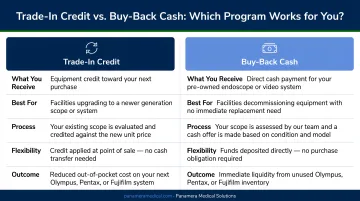
The best partners offer both, giving facilities the flexibility to choose based on their current capital position.
Why Partnering With a Specialist Matters
General asset disposal firms rarely understand the secondary market for endoscopic equipment. They lack the knowledge to distinguish between a functional Olympus GIF-H180 with strong international demand and a discontinued model with limited buyer interest, and that knowledge gap directly reduces what you're offered.
A specialist removes the operational burden of sourcing buyers, managing logistics, and negotiating prices for devices that require technical familiarity to assess. Rather than letting idle equipment accumulate maintenance costs past its performance peak, facilities recover measurable value and redirect that capital toward service quality.
7 Key Factors in Choosing Your Trade-In Program Partner
Not every trade-in partner is equipped to handle the technical and commercial nuances of endoscopic equipment. These 7 factors move evaluation beyond surface-level vendor selection and connect partner capabilities to real financial outcomes.
Factor 1: Specialized Endoscopy Domain Expertise
Endoscopic equipment is a narrow, technically complex category. Olympus alone holds approximately 70% of the global gastrointestinal endoscope market, with Fujifilm and Pentax/Hoya as significant competitors — each with distinct scope generations, connector types, and compatibility grades that affect resale value.
A generalist reseller won't know the difference between a video scope and a fiber-optic model, or how a GIF-HQ190 compares to a GIF-H180 in the current secondary market. That knowledge gap results in blanket valuations that undercount salvageable components and miss market-ready grades.
What to ask: Does the partner transact regularly in specific OEM brands you own? Can they assess condition across Olympus, Pentax, Fujifilm, and other major manufacturers by model and generation?
Panamera Medical Solutions works across all five major brands — Olympus, Pentax, Fujifilm, Karl Storz, and Stryker — with over fifteen years of active transactional experience across these product lines. That depth of exposure means valuations are grounded in what the secondary market actually pays, not generic estimates.
Factor 2: Global Buyer Network and Market Reach
Domestic demand for used endoscopes is finite. International healthcare markets — particularly in developing regions — actively seek functional, lower-cost endoscopic equipment that would otherwise be inaccessible at new-device prices.
The broader refurbished medical devices market reflects this: Asia-Pacific is the fastest-growing regional segment, projected to expand at an 11.12% CAGR through 2031. That growth is driven by healthcare system expansion in economies where budget-conscious procurement makes quality used equipment an attractive option.
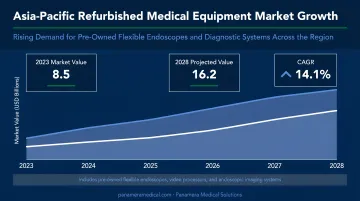
A partner with a global buyer network finds motivated buyers across multiple regions simultaneously — which creates competitive pricing pressure that a domestic-only partner simply cannot generate.
The KPI this affects: Recovery rate per device. More qualified buyers competing for your equipment means a higher final value.
Panamera's commercial network spans North America, Europe, and South America, connecting facilities with buyers who have genuine demand for the specific devices being traded — not just whoever happens to respond to a domestic listing.
Factor 3: Transparent and Fair Equipment Valuation
Used endoscope prices vary considerably. Secondary market listings show colonoscopes ranging from a few thousand dollars to tens of thousands, and gastroscopes spanning a similar range depending on model, generation, and condition. That dispersion is exactly why valuation methodology matters.
A trustworthy partner should be able to explain:
- How they grade cosmetic condition and functional status
- Which market comparables or transaction data they reference
- How device generation and OEM brand demand affect the quote
- Whether pricing reflects current market activity or static internal tables
Opaque pricing puts facilities at a disadvantage. Without a benchmark, it's impossible to know whether an offer represents fair market value or a margin play by the partner.
What to ask before accepting a quote: How did you arrive at this number, and what would change it?
Factor 4: Flexible Program Options (Credit vs. Cash)
Healthcare facilities don't all have the same capital needs at the same time. A facility mid-upgrade cycle may want trade-in credit applied directly toward the next equipment purchase. A facility managing a tight operating budget may need unrestricted cash to cover different expense lines.
A partner that only offers one option is structuring the program for their own margin optimization — not for your financial flexibility.
Why this matters operationally: A cash-only partner locks out facilities that need liquid capital — money that rightfully belongs to your budget. On the other side, a credit-only structure can result in a less favorable exchange rate when you move to the next equipment purchase.
Panamera offers both Trade-In Credit and Buy-Back Cash structures, allowing facilities to choose the option that fits their current capital position — not the one that's most convenient for the partner.
Factor 5: Financial Stability and Timely Payment
Trade-in and buy-back programs require the partner to hold real liquidity. They need to pay for devices upon receipt, issue credits without disrupting procurement timelines, and fund volume programs — like a full department equipment refresh — without staggered or deferred payments.
Partners with weak cash positions often delay payment or process devices in batches, which ties up your capital and throws off procurement planning.
Questions worth asking directly:
- What are your standard invoice terms for buy-back transactions?
- Can you fund a multi-device refresh simultaneously, or do payments phase over time?
- How do you handle payment if a valuation is disputed after receipt?
Financial stability is difficult to assess from a website. It requires direct conversation with the partner's commercial team.
Factor 6: Speed of Processing and Value Recovery
Medical equipment depreciates when new generations enter the market. Recent platform launches illustrate how quickly predecessor values shift:
- Olympus launched EVIS X1 across major markets between 2020 and 2023
- Pentax released its i20c series in January 2023
- Fujifilm introduced its next-generation ELUXEO system in the U.S. in October 2025 Each of those releases affected the secondary market value of predecessor models.
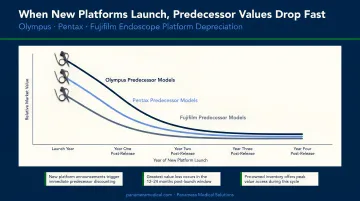
Every week a used scope sits unprocessed after you've initiated a trade-in is a week of value erosion. Fast processing — from device receipt to cash or credit issuance — directly affects total return.
The operational metric: Time-to-value recovery. Ask prospective partners how many calendar days elapse between device receipt and payment or credit issuance, and whether that timeline holds for volume transactions.
Factor 7: Compliance, Ethical Resale, and Patient Data Considerations
Used endoscopic equipment crosses regulatory jurisdictions when it's resold internationally. This creates compliance obligations that both the facility and the partner share.
Key areas to verify:
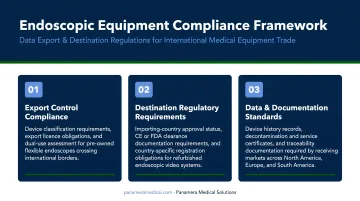
- Data clearance — Processors and integrated systems connected to hospital networks may contain electronic protected health information (ePHI). HIPAA requires covered entities to implement policies for ePHI removal before devices are reused or transferred
- Export compliance — FDA export requirements vary based on a device's U.S. marketing status. Devices exported under FD&C Act Section 801(e)(1) must satisfy specific statutory conditions before leaving the country
- Destination-country regulations — Import rules for used and refurbished medical devices differ by country. Compliance frameworks vary significantly across the U.S., EU, and other markets — verify destination requirements before any cross-border transfer
Facilities remain associated with how their devices are ultimately used. A partner that resells equipment into markets without proper compliance vetting creates reputational and legal exposure for the originating facility.
How Panamera Medical Solutions Can Help
Panamera Medical Solutions is a B2B specialist in endoscopic equipment trading with over fifteen years of international experience. The company's focus is deliberate: flexible endoscopes and video systems, not general medical equipment.
That specialization directly addresses each of the 7 factors above:
- Transactional experience across Olympus, Pentax, Fujifilm, Karl Storz, and Stryker — covering gastroscopes, colonoscopes, bronchoscopes, duodenoscopes, and related processors and light sources
- Buyer relationships across North America, Europe, and South America, which drives competitive valuations through real international demand
- Trade-In credit and Buy-Back cash structures available, so facilities choose based on actual capital needs — not program defaults
- Valuations grounded in live secondary market data for endoscopic equipment specifically, not generalized asset recovery estimates
For facilities in an upgrade cycle, that translates to a straightforward outcome: equipment that's no longer earning its place gets converted into credit toward newer scopes or direct cash — on terms that fit your procurement structure.
Conclusion
Choosing a trade-in program partner affects more than a line item in the procurement budget. It determines how much value your facility recovers from aging equipment, how quickly that capital becomes available for reinvestment, and whether the program supports or complicates your next upgrade cycle.
The right partner isn't the largest or most generic asset disposal firm — it's one whose expertise, network, and program terms align with your specific equipment profile and financial situation.
Treat the trade-in relationship as an ongoing strategic arrangement rather than a one-time transaction. Reviewing terms, valuations, and partner performance at each equipment cycle keeps the program competitive — and ensures you're capturing full market value every time you upgrade.
Frequently Asked Questions
Frequently Asked Questions
Are trade-ins ever worth it?
For endoscopic equipment, trade-ins make sense when devices are past peak performance but still functional. Recovering partial value toward a newer scope beats continued maintenance spending on aging equipment, and acting sooner protects against further depreciation.
Why do trade-in program partners want your used endoscopes?
Specialized partners acquire used endoscopes because global demand exists — particularly in emerging healthcare markets — for functional equipment that would otherwise be inaccessible at new-device prices. Used scopes are commercially viable products for international resale when matched with the right buyer network.
What types of endoscopic equipment can typically be traded in?
Most specialized partners accept gastroscopes, colonoscopes, bronchoscopes, duodenoscopes, and related processors and light sources. Eligibility depends on the device's functional condition, generation, and OEM brand demand within the partner's buyer network. Panamera Medical Solutions works across all major brands, including Olympus, Pentax, Fujifilm, and Karl Storz.
How is the value of used endoscopic equipment determined?
Valuation factors include device model and generation, functional and cosmetic condition grade, and current secondary market demand based on recent sales data. A specialist partner produces more accurate valuations than a generalist because they know what specific models actually sell for internationally.
Can a facility trade in equipment that still has remaining service life or a manufacturer contract?
Facilities should review existing service contracts or leasing agreements before initiating a trade-in, as some contracts include provisions affecting transferability. A reputable partner will guide the facility through an eligibility assessment before proceeding rather than accepting equipment that carries unresolved contractual obligations.