What makes EUS procurement complicated is the cost variability. A basic used setup can run $15,000–$50,000. A new premium system with full interventional capability can exceed $250,000. Between those endpoints, dozens of variables determine where your purchase lands.
This guide breaks down EUS equipment pricing tiers, what drives costs up or down, the full cost of ownership beyond the sticker price, and how to build a budget that actually holds.
Key Takeaways
- EUS equipment costs range from ~$15,000 (entry-level used) to $250,000+ (new premium system)
- Total system pricing covers three components — echoendoscope, ultrasound processor, and accessories — each quoted separately by vendors
- Refurbished EUS setups typically cost 40–60% less than new and suit most mid-tier clinical programs
- Recurring costs — needles, service contracts, and repairs — can match or exceed the original equipment investment over 3–5 years
- Matching system tier to actual procedure volume and clinical scope prevents both overspending and under-equipping
How Much Does Endoscopic Ultrasound Equipment Cost?
EUS equipment has no single price tag. The total system comprises three separately quoted components — the echoendoscope, the ultrasound processor, and procedure-specific accessories — and buyers who price only the scope routinely underbudget.
Three common mistakes drive cost surprises:
- Pricing the scope alone without accounting for the processor, installation, and single-use needle costs
- Selecting an incompatible configuration — a scope that doesn't match the facility's existing processor or endoscopy infrastructure requires expensive additional purchases
- Ignoring recurring costs — consumables and service contracts over a 3–5 year period can match or exceed the initial equipment investment
With those pitfalls in mind, here's how pricing breaks down across the three main budget tiers.
Entry-Level EUS Setup ($15,000–$50,000)
This tier typically covers a used or refurbished radial echoendoscope paired with a compatible (often refurbished) ultrasound processor. Expect basic EUS imaging capability and limited or no manufacturer warranty.
Best for smaller GI clinics adding EUS as a secondary capability, academic training programs, or facilities entering EUS on a constrained budget. This tier supports diagnostic imaging but generally does not support EUS-guided FNA/FNB or other interventional procedures.
Mid-Range EUS Setup ($50,000–$120,000)
At the top tier, buyers are purchasing new premium-brand hardware: an Olympus, Pentax Medical/Hoya, or Fujifilm echoendoscope with high-definition imaging, a latest-generation ultrasound processor with full elastography, contrast-enhanced EUS, and advanced Doppler, plus a comprehensive accessory package, manufacturer warranty, and onsite training.
Tertiary care centers, high-volume pancreaticobiliary programs, and cancer centers requiring advanced EUS-guided interventions operate at this level. For a pricing anchor: the Olympus GF-UCT180 — a curvilinear array scope built for tissue sampling and EUS-guided treatment — carries a VA Federal Supply Schedule reference price of $74,948 per unit, before processor and accessories are added.
Key Factors That Affect EUS Equipment Cost
EUS equipment costs vary widely depending on scope type, condition, brand, processor compatibility, and ongoing consumable spend. Getting each of these right upfront prevents the far more expensive problem of buying equipment that doesn't fit your program's actual clinical workflow.
Echoendoscope Type and Configuration
The single largest cost variable is scope type:
- Radial echoendoscopes provide 360° circumferential imaging — ideal for diagnostic staging and anatomical assessment, and generally lower in cost
- Linear (curved linear array) echoendoscopes enable interventional procedures including EUS-FNA, EUS-FNB, cyst drainage, and fiducial placement — they cost more and are required for any interventional program
- Large-channel therapeutic scopes (such as the Pentax EG38-J10UT or Fujifilm EG-740UT, each with 4.0 mm working channels) carry additional price premiums for expanded therapeutic accessory compatibility
Facilities that need both radial and linear scopes face a meaningfully higher total investment than those requiring a single configuration.
Condition — New, Refurbished, or Used
| Condition | Cost Profile | Risk Profile |
|---|---|---|
| New | Highest cost; full manufacturer warranty | Lowest risk |
| Refurbished | 40–60% less than new; varies by source | Low-to-moderate, depending on refurbishment standards |
| Used/as-is | Most affordable | Highest risk without verified service history |
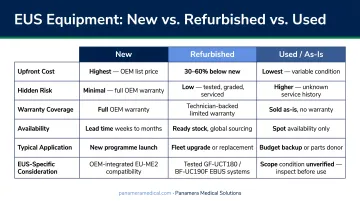
The FDA distinguishes between servicing (returning a device to OEM safety and performance specifications) and remanufacturing (which significantly changes those specifications). When evaluating refurbished EUS equipment, confirm which category applies and verify the refurbishment process against ANSI/AAMI ST91:2021 standards for flexible endoscope processing.
Olympus offers a Certified Pre-Owned program where equipment is fully refurbished and inspected, carrying the same one-year warranty as new Olympus products — a useful benchmark when comparing third-party refurbished sources. Panamera Medical Solutions also sources and sells refurbished EUS equipment including the Olympus GF-UCT180, with service available through authorized providers.
Brand, Model, and Generation
The three major EUS brands — Olympus, Pentax Medical/Hoya, and Fujifilm — each use proprietary processor platforms that lock scope and processor selection together:
- Olympus: GF-UCT180 (curvilinear array scope); EU-ME3 ultrasound processor; Full Service Agreement with fixed annual pricing
- Pentax Medical/Hoya: EUS-J10 line; ARIETTA Series ultrasound processors; INSPIRA video processor compatibility
- Fujifilm: EG-740UT curved linear scope; SU-1 processor supporting both convex and radial scanning models
Premium brands command higher prices but offer stronger service networks and parts availability — factors that affect long-term total cost of ownership more than they affect the purchase price.
Newer-generation scopes with advanced elastography, contrast-enhanced EUS, or high-definition imaging cost significantly more than previous-generation models. Evaluate whether those features align with actual clinical protocols before paying the premium.
Processor Compatibility and System Integration
Processor-scope mismatches are one of the most common — and avoidable — cost surprises in EUS procurement. A scope purchased from one source without confirming processor compatibility can require a full processor replacement, turning a bargain purchase into an over-budget project.
Additional integration costs that rarely appear in quoted equipment prices:
- PACS/DICOM connectivity configuration
- Integration with existing endoscopy video towers
- Hospital IT infrastructure setup
- Staff training — ASGE competency guidelines reference a minimum of 125–150 supervised cases for EUS proficiency, which has real scheduling and cost implications
EUS Accessories and Consumable Costs
Beyond capital equipment, per-procedure consumable costs add up quickly and belong in any honest budget model. EUS-FNA and EUS-FNB needles are single-use items; a 2013 AJG abstract put FNA needle costs at roughly $315 per case and FNB at approximately $410 per case — figures that have likely risen with inflation. At a high-volume center running hundreds of EUS procedures annually, needle spend alone can reach tens of thousands of dollars.
Additional per-procedure accessories to budget for:
- Biopsy forceps
- Cyst drainage systems and stents (e.g., lumen-apposing metal stents for EUS-guided gallbladder drainage)
- Fiducial marker delivery devices (requiring 19, 22, or 25 gauge needles; pancreatic cancer cases typically need at least 3 markers)
Full Cost of Ownership: What to Budget Beyond the Equipment
Facilities that budget only for the hardware consistently face unplanned expenses in year one. Here's how the full cost breaks down:
| Cost Category | Type | Notes |
|---|---|---|
| Echoendoscope + processor | One-time | Core system; price tiers in section above |
| Installation and setup | One-time | PACS/DICOM integration, power/space requirements, staff training; costs vary widely by facility readiness |
| EUS-FNA/FNB needles | Recurring | Per-procedure; forecast based on anticipated volume |
| Other single-use accessories | Recurring | Drainage systems, fiducials, forceps |
| Annual service contract | Recurring | Fixed annual price (Olympus Full Service Agreement covers repairs including accidental damage with no cap) |
| Scope repairs | Periodic | 2004 survey of 56 institutions: avg. $10,534/year, or ~$41 per procedure |
| Scope refurbishment or replacement | Periodic | Plan for regular intervals based on manufacturer guidance and actual usage cycles |
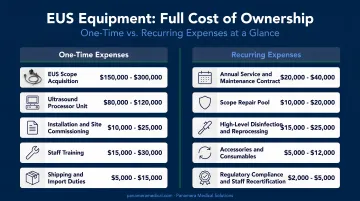
The repair data dates to 2004, but the pattern holds: curved linear array scopes last through roughly 107 procedures before failure, versus ~68 for mechanical radial scopes. For interventional programs, that durability gap helps justify the higher upfront cost.
How to Estimate the Right Budget for EUS Equipment
Start With Clinical Scope
The first question is binary: diagnostic-only or interventional?
- Diagnostic-only EUS → radial echoendoscope sufficient → lower system cost
- Interventional EUS (FNA/FNB, drainage, fiducials) → linear echoendoscope required → higher system cost
Resolving this before pricing anything else eliminates the most common source of spec mismatch.
Match Tier to Volume and Reliability Requirements
- High-volume GI or oncology programs: New premium systems justify higher upfront costs through reduced downtime, longer useful life, and full manufacturer support
- Lower-volume facilities or secondary EUS services: Quality refurbished configurations typically deliver better return on investment — and the 40–60% cost reduction is material at this scale
Build Total Cost of Ownership Into the Budget From Day One
Add these to the equipment purchase price before finalizing any budget:
- Installation, PACS/DICOM setup, and staff training
- Annual service contract
- Projected annual needle and accessory spend (based on anticipated procedure volume)
- Periodic scope repair or refurbishment reserve
Facilities that skip this step routinely find their actual first-year spend 20–30% above the purchase price.
Offset Upgrade Costs With Trade-In and Buy-Back Programs
Facilities replacing existing EUS equipment can recover real value from older scopes and processors. Panamera Medical Solutions offers Trade-In and Buy-Back programs covering echoendoscopes and ultrasound processors, letting facilities credit unneeded equipment toward a newer-generation system or convert it directly to cash.
Older-generation EUS equipment that no longer fits your program isn't necessarily without value. With a buyer network spanning North America, Europe, and South America, there are often motivated buyers for equipment you've outgrown.
Common Budgeting Mistakes to Avoid
- Fixating on the lowest purchase price without verifying service history or processor compatibility
- Ignoring recurring consumable and maintenance costs
- Over-specifying a full interventional system for a program that only needs diagnostic capability
- Purchasing EUS equipment without confirming compatibility with the existing endoscopy infrastructure
Frequently Asked Questions
How much does an endoscopic ultrasound machine cost?
EUS equipment costs range from $15,000–$50,000 for a basic used or refurbished setup to $120,000–$250,000+ for a new high-end system. The total cost includes the echoendoscope, ultrasound processor, and accessories — each priced separately, so buyers need to quote the full system, not just the scope.
What is the difference between a radial and linear echoendoscope, and how does it affect price?
Radial echoendoscopes provide 360° diagnostic imaging and typically cost less. Linear (curved linear array) scopes enable interventional procedures like EUS-FNA and EUS-FNB and cost more. Facilities that need both types face the highest total equipment investment.
Is refurbished EUS equipment reliable enough for clinical use?
Professionally refurbished EUS equipment restored to OEM performance standards can be clinically reliable and typically costs 40–60% less than new. Before purchasing, verify the refurbishment process, confirm compliance with applicable processing standards, and review warranty terms.
What are the ongoing annual costs of running an EUS program?
Recurring costs include EUS-FNA/FNB needles (roughly $315–$410 per case), annual service contracts, and periodic scope repairs or replacements — totals that can match or exceed the original equipment investment over several years.
How long do EUS echoendoscopes typically last before needing replacement?
No manufacturer guidance on lifespan in years is publicly available. A survey of 56 institutions found mechanical radial scopes failed after ~68 procedures and curved linear-array scopes after ~107 procedures on average — high-volume centers should factor this into lifecycle budgeting.
Can I trade in or sell my existing EUS equipment when upgrading?
Yes — older EUS echoendoscopes and processors often retain meaningful resale value through specialized medical equipment trading platforms and buy-back programs. Panamera Medical Solutions accepts EUS equipment through its Trade-In and Buy-Back program, offering credit toward newer-generation equipment or a direct cash-out option for unneeded scopes and processors.