Introduction
The ASGE recorded over 7.4 million upper endoscopy procedures in the US in 2019 alone. At that scale, scope quality has real clinical consequences: image clarity, operator ergonomics, and handling all affect procedural consistency and patient comfort across a full day of cases.
The Pentax Medical EG27-i20c is the upper GI scope in Pentax's i20c generation — a slim-caliber video gastroscope (a division of HOYA Group) built for the INSPIRA™ EPK-i8020c imaging ecosystem.
It received CE mark in February 2024 and FDA 510(k) clearance (K241213) in December 2024.
This article covers what the EG27-i20c is, its key design features, imaging technology, clinical applications, and what facilities should consider when evaluating an upgrade.
Key Takeaways
- The EG27-i20c is a slim-caliber HD+ video gastroscope with a 9.2 mm insertion tube and 2.8 mm instrument channel
- ErgoFeel control body and EasyOn connector reduce operator fatigue in high-volume endoscopy settings
- i-scan OE provides real-time virtual chromoendoscopy without dye spraying
- Designed for pairing with the INSPIRA EPK-i8020c processor, which also supports older Pentax scopes
- Facilities upgrading from Pentax i10 series equipment can apply trade-in and buy-back programs to offset acquisition costs
What Is the Pentax Medical EG27-i20c?
The EG27-i20c is officially listed as a Video Gastroscope HD+ (i20c Series) in the Pentax Medical catalogue. It's part of the broader i20c endoscope generation — a family that includes colonoscopes — and is engineered to deliver its full performance when paired with the Pentax Medical INSPIRA™ Video Processor EPK-i8020c.
Regulatory Status and Background
Pentax announced CE mark for the i20c series on February 24, 2024, and FDA 510(k) clearance (K241213) followed on December 6, 2024, with Pentax's public announcement on December 10, 2024.
With both CE and FDA clearances secured, the EG27-i20c carries forward the core design principles of the i20c generation:
- Ergonomic refinement for reduced operator fatigue
- HD+ imaging for sharper diagnostic clarity
- Seamless integration with the EPK-i8020c processor
It also introduces a slim insertion tube profile suited for specific patient populations. The clinical objective is direct: give high-volume endoscopy teams equipment that reduces procedural strain without compromising diagnostic capability.
Key Features of the Pentax Medical EG27-i20c
ErgoFeel Control Body
The ErgoFeel control body is the standout ergonomic feature of the i20c series. It redesigns the control section to optimize hand positioning and reduce strain during back-to-back procedures. ASGE reports endoscopy-related injury prevalence of 39–89% among practicing gastroenterologists, with hands, fingers, and the back most commonly affected. The ErgoFeel design directly reduces the muscular effort required to hold and maneuver the scope across a full procedure list.
EasyOn Lightweight Connector
The EasyOn connector reduces the weight and drag felt at the scope's connection to the video processor. Less cable resistance during maneuvering translates directly to reduced hand and wrist fatigue across a full procedure list — an effect that becomes more pronounced in high-volume endoscopy settings.
Slim Caliber Design
The EG27-i20c has a 9.2 mm outer diameter insertion tube — slim within the i20c gastroscope lineup. The instrument channel measures 2.8 mm, maintaining therapeutic utility while keeping the insertion profile narrow. This dimension is relevant for specific patient populations discussed in the clinical applications section below.
Angulation and Field of View
The scope's technical specifications confirm superior angulation range:
- Up: 210°
- Down: 120°
- Right/Left: 120° each
- Field of view: 140°
- Depth of field: 2–100 mm
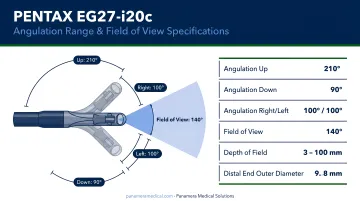
This angulation range supports thorough mucosal inspection of the esophagus, stomach, and duodenum with fewer repositioning attempts.
OE-B17 Right/Left Wheel Extender
The OE-B17 is a reusable accessory that improves access to the outer angulation wheel, particularly for endoscopists with smaller hands. CE mark was confirmed alongside the i20c series in February 2024.
Advanced Imaging: i-scan OE and HD+ Visualization
i-scan Optical Enhancement (OE)
i-scan OE is Pentax Medical's virtual chromoendoscopy technology — a combination of digital and optical image enhancement that sharpens mucosal surface detail, vascular patterns, and tissue contrast in real time, without requiring dye spraying.
The clinical evidence supports it as a useful tool in upper GI settings, though with some nuance:
- A 2019 study (n=41) found OE improved Barrett's esophagus-associated neoplasia detection accuracy for both trainees (76% vs 63%) and experts (84% vs 77%) compared to HD white light
- A 2022 study (n=328) reported sensitivity of 0.96 vs 0.50 for gastric intestinal metaplasia detection when OE was combined with magnification
- A separate 2022 trial (n=112) found i-scan OE was not superior to chromoendoscopy for horizontal margin delineation in gastric epithelial neoplasms
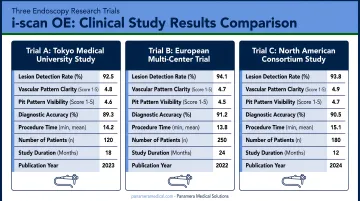
i-scan OE is a clinically relevant enhancement tool for Barrett's surveillance and gastric mucosal characterization. It is not a universal replacement for chromoendoscopy in every scenario, but the evidence supports its routine use in these specific applications.
HD+ Imaging and the INSPIRA Processor
The EG27-i20c is classified as HD+ and delivers its full imaging output when connected to the INSPIRA EPK-i8020c processor. Key hardware specifications include:
- 4K resolution support via the INSPIRA EPK-i8020c processor
- 5-LED illumination system for consistent, color-accurate lighting throughout procedures
- Color differentiation optimized for distinguishing normal mucosa, intestinal metaplasia, and early mucosal changes in the upper GI tract
Color accuracy is particularly relevant here — subtle tissue variation in the upper GI tract is often the first indicator of pathological change.
BSG/AUGIS quality standards for upper GI endoscopy specify that high-definition video systems are required for adequate mucosal visualization — the INSPIRA-i20c combination meets that standard.
Clinical Applications and Compatible Patient Populations
Standard Upper GI Procedures
The EG27-i20c is suited for routine esophagogastroduodenoscopy (EGD), including:
- Diagnostic inspection of the esophagus, stomach, and duodenum
- Mucosal biopsy
- Hemostasis and basic therapeutic interventions
- Surveillance procedures for Barrett's esophagus or gastric intestinal metaplasia
Its 2.8 mm instrument channel accommodates standard biopsy forceps and therapeutic accessories, making it a functional choice for departments running high volumes of both diagnostic and therapeutic upper GI work.
Pediatric and Slim-Patient Populations
The 9.2 mm outer diameter positions the EG27-i20c as a slim option within the adult gastroscope range. NASPGHAN guidance notes that slim adult gastroscopes around 7.8–9.0 mm OD are referenced for smaller pediatric patients, while children over approximately 20 kg can generally tolerate adult-size gastroscopes with a 2.8 mm working channel.
The EG27-i20c's 2.8 mm channel aligns with that adult-size working-channel profile. It is not an ultrathin neonatal scope; ASGE pediatric equipment guidance recommends 4.9–6.0 mm scopes for children under 10–15 kg. For older pediatric patients, adolescents, and adults with anatomical considerations — such as post-bariatric surgery anatomy or esophageal narrowing — the EG27-i20c is appropriate, subject to clinician assessment.
Workflow Implications for Busy Endoscopy Units
For endoscopy units running procedure lists of 20–30 patients per day, cumulative ergonomic strain is a real operational concern. The combination of the ErgoFeel body, EasyOn connector, and OE-B17 wheel extender reduces the physical demands on the endoscopist across that full list — which can support more consistent scope control during late-day procedures when fatigue typically accumulates.
System Compatibility: Pairing with the INSPIRA EPK-i8020c
The EG27-i20c is designed to work with the Pentax Medical INSPIRA™ Video Processor EPK-i8020c. Key processor features that support the scope include:
- 4K resolution image processing
- 5-LED illumination for consistent, color-accurate lighting
- i-scan and i-scan OE for real-time image enhancement
- Touchscreen control and patient data management
Backward Compatibility
The INSPIRA processor uses a dual-connection design — a classic connector port for existing Pentax endoscope generations and a new connector port for i20c series scopes. Facilities adopting the INSPIRA can keep using older scopes, such as the EG-29-i10, alongside new i20c models on the same processor during a staged transition. There's no need to replace the entire inventory at once.
The INSPIRA processor received FDA 510(k) clearance (K231249) in July 2023 and CE mark in March 2023, covering both US and European markets for use with the i20c series.
Upgrading Your Endoscopy Suite to the Pentax Medical i20c
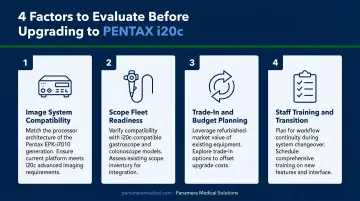
Facilities evaluating the EG27-i20c typically weigh several factors before committing:
- Imaging platform compatibility — does your current processor support i20c scopes, or does the upgrade require new processor investment?
- Ergonomic ROI — given documented injury rates among endoscopists, equipment that reduces cumulative strain has genuine operational value beyond image quality alone
- Staged vs. full transition: the INSPIRA's backward compatibility means facilities can introduce i20c scopes incrementally rather than replacing their entire Pentax inventory at once
- Existing equipment value — older Pentax gastroscopes and processors (such as the EPK-i7010) retain residual value in the secondary market, which can offset the cost of moving to the newer generation
For facilities in North America, Europe, and South America looking to offset upgrade costs, Panamera Medical Solutions specializes in purchasing, selling, and servicing endoscopic equipment — with over fifteen years of international trading experience. Their trade-in and buy-back programs let facilities sell older Pentax upper GI scopes and processors, receiving either credit toward newer equipment or a direct cash buyout through a global buyer network spanning three continents.
Panamera currently stocks and services prior-generation Pentax equipment including the EG-29-i10 gastroscope and EPK-i7010 processor. Facilities moving from i10-series to i20c equipment can sell back existing inventory directly, reducing the net cost of the transition.
Frequently Asked Questions
What is the Pentax Medical EG27-i20c used for?
The EG27-i20c is a slim-caliber HD+ video gastroscope used for esophagogastroduodenoscopy (EGD), mucosal biopsy, and therapeutic upper GI procedures. Its 9.2 mm insertion tube makes it particularly well-suited for older pediatric patients, adolescents, and adults with anatomical narrowing or post-bariatric surgery anatomy, based on clinical assessment.
How does the Pentax i20c upper endoscope differ from previous Pentax models?
The i20c generation introduces the ErgoFeel control body for improved hand positioning, the EasyOn lightweight connector to reduce procedural fatigue, and the OE-B17 wheel extender for smaller-handed operators. It also delivers HD+ imaging with i-scan OE and 4K resolution capability via the INSPIRA processor, advancing ergonomics and imaging beyond the prior i10-series.
Is the Pentax EG27-i20c compatible with the INSPIRA video processor?
Yes. The EG27-i20c is designed for use with the Pentax Medical INSPIRA™ EPK-i8020c processor. The INSPIRA's classic connector port also maintains compatibility with older Pentax endoscope generations, which supports upgrades across mixed-inventory facilities.
How long does it take to recover from an upper GI endoscopy?
Most patients remain in recovery for approximately one hour while sedation wears off, per NIDDK guidance. Sedation effects on alertness and coordination may persist for several hours, so patients are typically advised not to drive on the day of the procedure.
Can an upper endoscopy detect pancreas problems?
Standard upper endoscopy visualizes the esophagus, stomach, and duodenum and does not provide direct visualization of the pancreas. ERCP (endoscopic retrograde cholangiopancreatography) is the primary endoscopic tool for assessing pancreatic and biliary duct conditions.
Are you fully asleep for an upper GI endoscopy?
Patients typically receive moderate sedation (conscious sedation) rather than general anesthesia, meaning they are relaxed and drowsy but not fully unconscious. ASGE and SAGES guidance confirms that diagnostic and uncomplicated therapeutic upper endoscopy are routinely performed under moderate sedation, though protocols vary by facility and patient need.