Introduction
Refurbished products promise real savings — Apple's certified refurbished store advertises up to 15% off, while Dell Outlet markets savings of up to 30%. Yet many buyers hesitate, unsure whether "refurbished" means professionally restored or just a cleaned-up return that failed quality control.
The honest answer: trustworthiness has almost nothing to do with the word "refurbished" itself. It depends entirely on who did the refurbishing, under what standards, and what protections come with the purchase.
This guide covers what you need to know before buying refurbished:
- What "refurbished" actually means across different sellers and contexts
- How to read the trust signals that separate reliable sources from risky ones
- Red flags that indicate a product isn't worth the discount
- Which product categories carry higher risk
- Why healthcare settings — especially facilities sourcing refurbished endoscopic equipment — require a stricter standard of scrutiny
Key Takeaways
- "Refurbished" has no universal legal definition — seller credentials and process determine trustworthiness
- OEM-certified refurbishment programs set the standard; third-party programs vary widely in quality
- Warranty coverage is the single most reliable trust indicator
- High-complexity equipment — medical devices especially — carries greater refurbishment risk than standard electronics
- In medical settings, regulatory compliance and documented service history are non-negotiable
What Does "Refurbished" Actually Mean?
"Refurbished" covers a wide spectrum, and understanding where a product falls on that spectrum matters more than the label itself.
The Spectrum of Pre-Owned Products
| Type | What It Means | Warranty? |
|---|---|---|
| Open-box | Customer return, retailer-inspected, usually not factory-repaired | Varies |
| Manufacturer-refurbished | Tested and restored to original equipment manufacturer (OEM) standards, genuine parts | Usually yes |
| Third-party refurbished | Repaired by outside party, may use non-OEM parts | Varies |
| Used | Sold as-is, no inspection or repair | Rarely |
| Grade | Condition Description | Cosmetic State | Functional Testing | Warranty Status |
|---|---|---|---|---|
| Grade A | Fully refurbished to manufacturer-equivalent performance standards | Minimal cosmetic wear, professional cosmetic restoration applied | Comprehensive bench test, leak test, optical and angulation verification | Included |
| Grade B | Fully functional, minor cosmetic wear accepted | Light scratches or scuffing, no structural damage | Full functional and leak test verified | Limited |
| Grade C | Functional with noted cosmetic or minor repair history | Visible wear, staining, or repaired cosmetic blemishes | Functional test passed, known issues disclosed | As-Is / 30-Day |
| Grade D | For parts or repair use only, sold untested or non-functional | Heavy wear, damage, or incomplete unit | Not functionally tested or sold for parts only | No Warranty |
Note: These grade definitions are Panamera Medical Solutions' internal classification standards applied across all pre-owned and refurbished flexible endoscopes. Each grade directly determines the scope of inspection performed, the level of cosmetic and functional restoration carried out, and the warranty coverage extended to the buyer. Grade A units undergo the most comprehensive refurbishment and carry full warranty inclusion, while Grade D units are sold exclusively for parts or repair purposes with no warranty. Panamera discloses all known conditions at point of sale, with inspection documentation available upon request.
Terms like "renewed," "reconditioned," and "pre-owned" are often used interchangeably — but they may imply very different processes depending on the seller.
Refurbished vs. Used: A Critical Distinction
A used product is sold as-is. No testing, no repairs, no guarantees. A properly refurbished product has been inspected, repaired where needed, cleaned, and typically comes with some form of warranty.
For healthcare facilities evaluating equipment, that difference between "as-is" and "actively certified" has direct implications for patient safety and operational reliability.
Why Returns Happen
Many refurbished units were never defective to begin with. In medical equipment markets, common return reasons include:
- Facility upgrades replacing functional older models
- Surplus inventory from consolidations or department closures
- Cosmetic blemishes with no impact on performance
- Demo units used for training or evaluation purposes
A significant portion of refurbished inventory enters the market in fully functional condition — it simply no longer fits the original owner's needs.
Can You Really Trust Refurbished Products?
Refurbished products are trustworthy when the seller is credible and the process is documented — two conditions that are increasingly met across both consumer and institutional markets.
IDC forecasts the worldwide used smartphone market will surpass 431 million units and reach $109.7 billion in value by 2027, growing at an 8.8% CAGR from 2022. In healthcare, the same shift is playing out with high-value capital equipment — including endoscopes, processors, and light sources. The question isn't whether to consider refurbished; it's how to evaluate the programs behind them.
Why Certified Refurbs Can Rival New Products
Certified refurbished equipment goes through individual inspection and functional testing — something that doesn't happen on a production line. In medical equipment, this matters even more, because a scope leaving a facility has a usage and repair history that can be fully evaluated before resale.
Rigorous programs from major endoscopy manufacturers typically include:
- Multi-point functional testing: Image quality, angulation range, channel integrity, and leak resistance verified against original specifications
- Genuine OEM parts: Worn components replaced with manufacturer-sourced parts, not aftermarket substitutes
- Full cleaning and reprocessing: Equipment sterilized and inspected to clinical standards before shipment
- Documented history: Service records and prior repair logs available to the buyer
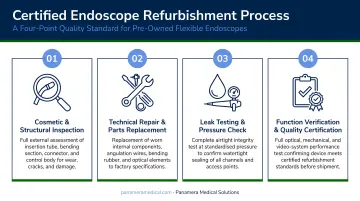
Each unit receiving this level of scrutiny often arrives in better-documented condition than new equipment shipped straight from a warehouse.
Warranty: The Most Important Trust Signal
A product sold without a warranty tells you something important — the seller doesn't trust the product's longevity. Here's a practical benchmark:
- Red flag: No warranty, or coverage under 30 days
- Acceptable: 90-day warranty from a credible specialist seller
- Strong signal: One year or more from manufacturer-certified programs
In the medical equipment space, reputable traders often provide 90-day to one-year warranties on refurbished endoscopes, with extended coverage available depending on scope condition and grade. Always confirm what the warranty covers — parts, labor, and turnaround time all matter for clinical operations.
OEM Parts vs. Third-Party Replacements
A seller who uses non-original parts without disclosure undermines trust. OEM parts offer better compatibility, performance, and longevity — particularly in precision instruments like flexible endoscopes, where tolerances are tight and failure has clinical consequences.
When evaluating a refurbished equipment seller, ask directly:
- Are replacement parts sourced from the original manufacturer or authorized distributors?
- Is the parts policy disclosed in writing before purchase?
- Can the seller provide documentation for any components replaced during refurbishment?
If a seller can't answer these questions clearly, that's a signal worth taking seriously.
Green Flags: How to Know a Refurbished Product Is Trustworthy
Verified Seller with a Track Record
The safest starting points, in order:
- OEM-certified refurbishment programs (Olympus, Pentax, Fujifilm, Karl Storz) — the benchmark for documented quality
- Certified third-party specialists with publicly documented refurbishment processes
- Established B2B dealers with verifiable transaction history, references from healthcare facilities, and transparent inspection protocols
Avoid individual marketplace sellers for high-value purchases unless the platform provides purchase protection.
Grading Transparency
Reputable sellers use condition grades with specific descriptions:
- Grade A / Like New: Minimal or no cosmetic wear, full functionality
- Grade B / Good: Minor visible wear, full functionality
- Grade C / Fair: Noticeable cosmetic wear, fully functional
Vague language like "may show signs of use" without specifics is a warning sign, not a description. For medical equipment, cosmetic grading alone isn't enough — verify that functional and clinical performance criteria (optical clarity, channel integrity, angulation range) are documented separately.
Documented Refurbishment Process
A credible process typically includes:
- Diagnostic testing of all hardware functions
- Battery replacement (critical for phones and laptops)
- Component repair or replacement where failures were found
- Full data wipe and OS reinstall
- Physical cleaning
- Final inspection before packaging
For medical equipment, the equivalent benchmark is an OEM-certified or ISO 13485-aligned process: leak testing, optical channel inspection, angulation verification, OEM-spec component replacement, and a documented pre-shipment inspection report. That level of transparency is what separates a credible refurbisher from a reseller who cleaned the exterior and called it refurbished.
Return Policy and Device Verification
- Minimum 30-day free return window is non-negotiable. "All sales final" on a refurbished product is unacceptable.
- For medical equipment, always request the device's full service and repair history, and verify the serial number against the manufacturer's records. Check the FDA's MedWatch database for any outstanding recalls on the specific model. Confirm the equipment hasn't been written off, reported stolen, or decommissioned by the originating facility — a reputable seller will provide documentation proactively.
Red Flags: How to Spot a Low-Quality Refurbished Listing
Not every refurbished listing is created equal. These warning signs indicate a seller cutting corners — or worse, misrepresenting what they're selling:
No process documentation: If a seller can't describe what was tested, replaced, or held to what standard, treat that as a serious concern. Legitimate refurbishers lead with their process — it's their core value proposition.
Absent or minimal warranty: Coverage under 30 days suggests the seller already knows something may fail. Once a 15-day warranty expires, your recourse is essentially nothing.
Pricing dramatically below market: Refurbished products should cost less than new — but prices far below the certified refurb rate for that product typically signal corner-cutting: non-OEM parts, skipped testing, or misrepresented condition. Cross-reference pricing across multiple certified platforms before committing.
Vague listing language: Watch for these specific patterns:
"Fully tested" with no detail on what was tested
No mention of what was repaired or replaced
Inconsistent or missing product photos
No condition grade or grading system
"Renewed" used as a catch-all without certification context
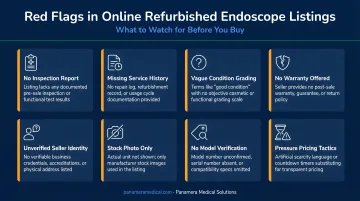
The FTC treats failure to disclose used or reconditioned status at the point of sale as an unfair or deceptive practice. Sellers who hide the ball on condition are not just untrustworthy — they may be acting illegally.
Which Products Are Safe — and Risky — to Buy Refurbished
Generally Safe
Consumer Reports endorses refurbished smartphones, laptops, and tablets from reputable sellers with warranty coverage — and the same logic applies to clinical equipment. These categories work well because their components are testable, replaceable, and well-documented:
- Medical video processors and light sources (from certified dealers)
- Flexible endoscopes that have undergone full inspection and functional testing
- Laptops, tablets, and workstations (manufacturer-certified programs)
- Household appliances with manufacturer warranty
- Audio gear from established brands
Higher Risk Categories
Some products carry inherent refurbishment limitations:
- Storage drives (HDDs/SSDs): Wear accumulates invisibly. A drive's remaining lifespan can't be fully guaranteed even with SMART testing, and replacement isn't always cost-effective.
- Earbuds and in-ear audio: Hygiene concerns and acoustic seal degradation from use can't be fully restored.
- Televisions: Screen wear — including burn-in, backlight degradation, and pixel fatigue — is difficult to quantify and may not appear until extended use.
- Power supplies: Capacitor wear and component stress aren't easily detectable without specialized equipment.
- Flexible endoscope insertion tubes: Bending rubber and angulation wires degrade with use cycles. Visual inspection alone won't reveal internal stress fractures or fluid ingress points.
The Critical Caveat
These category distinctions only tell part of the story — the seller's process determines far more than the product type alone. A smartphone from a random marketplace reseller is a gamble. The same model through Samsung's Certified Re-Newed program is not. The same holds for medical equipment: an endoscope sourced through a specialist with documented inspection protocols is a fundamentally different purchase than one sold with no service history. Who refurbishes it, and how, matters more than what it is.
Why Refurbished Medical Equipment Requires a Higher Standard of Trust
In clinical settings, refurbished equipment — endoscopes in particular — is standard practice. MarketsandMarkets estimates hospitals and diagnostic centers can save 30–50% by choosing refurbished units over new, and the global refurbished medical equipment market is projected to grow from $16.93 billion in 2024 to $24.41 billion by 2029.
The economic logic is sound. The trust criteria, however, must be far more rigorous than for consumer electronics. A malfunctioning endoscope affects patient safety directly — the stakes have no comparison to a faulty laptop or phone.
What a Trustworthy Medical Equipment Supplier Looks Like
Apply the same green-flag checklist from above, but weight each factor more heavily:
- Deep category specialization: A supplier who trades only in endoscopic equipment understands the clinical standards, the OEM servicing requirements, and the nuances of individual device types in ways a generalist broker cannot match.
- Documented servicing protocols: Request specifics. What was inspected? What was replaced? Was the work performed by brand-certified technicians using OEM parts?
- International sourcing network: A credible supplier with verified sourcing across multiple markets reduces the risk of acquiring equipment with unknown service histories or compromised provenance.
- Equipment lifecycle support: Trade-in and buy-back programs indicate that a supplier understands the full equipment lifecycle and maintains ongoing relationships with healthcare facilities, rather than operating as a transactional reseller.
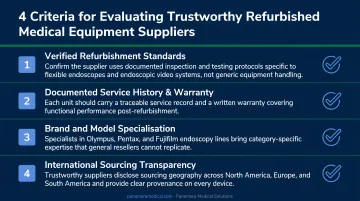
Panamera Medical Solutions operates within this model — 15+ years of international endoscopy trading, sourcing across North America, Europe, and South America, with category focus across Olympus, Pentax, Fujifilm, Karl Storz, and Stryker equipment.
For Healthcare Procurement Managers
Before committing to any supplier of refurbished endoscopic equipment:
- Verify ISO 13485 quality management certification where applicable
- Confirm the supplier is a member of recognized industry bodies (e.g., IAMERS, which requires members to sign a code of ethics for used and refurbished medical equipment)
- Request explicit documentation of the servicing process for your specific device type
- Clarify warranty terms, service availability, and return recourse in writing before purchase
Generalist medical equipment brokers rarely carry the category-specific knowledge required to assess whether a colonoscope or duodenoscope meets the standards your facility and patients require.
Frequently Asked Questions
Can I trust refurbished products?
Yes — when purchased from certified sellers who offer transparent refurbishment processes, condition grading, and meaningful warranty coverage. The word "refurbished" alone means nothing; the seller's credentials and guarantees are what determine whether the purchase is sound.
How do I spot a fake refurbished product?
Watch for these red flags:
- No documented refurbishment process
- Absent or minimal warranty
- Prices well below certified refurb market rates
- Vague listing language with no condition grading
- No way to verify serial number or IMEI status
Why are refurbished items cheaper?
Once a product has been returned or previously owned, it cannot legally be sold as new — prior ownership and cosmetic wear must be reflected in the price.
What is the difference between refurbished and used?
A used product is sold as-is by an individual seller, with no inspection, repairs, or warranty. A refurbished product has been professionally inspected, tested, repaired where needed, and typically includes some form of warranty.
Does refurbished mean the product was broken?
Not necessarily. Many were returned for buyer's remorse, cosmetic blemishes, or packaging damage — never a functional fault. Even units returned for a malfunction are repaired and must pass testing before any credible seller lists them as refurbished.