Despite how routine the procedure is, two things consistently stop people from scheduling one: anxiety about what happens during the exam, and uncertainty about what it will cost.
This guide covers both. You'll learn what a colonoscopy actually involves, who needs one and when, how much it costs with and without insurance, and exactly what to expect before, during, and after the procedure.
Key Takeaways
- Colorectal cancer screening is recommended for all adults aged 45–75 by the U.S. Preventive Services Task Force
- Costs range from $1,250 to $4,800+ depending on location, facility type, and whether polyps are removed
- Ambulatory surgery centers charge roughly 54–61% less in facility fees than hospital outpatient departments
- Screening colonoscopies are typically covered at 100% under the ACA, though polyp removal during the procedure can trigger cost-sharing
- The scope itself takes 30–60 minutes; plan for 2–3 hours total at the facility
What Is a Colonoscopy?
A colonoscopy is a procedure in which a gastroenterologist uses a flexible tube equipped with a small camera — called a colonoscope — to examine the lining of the rectum and colon. According to the National Institute of Diabetes and Digestive and Kidney Diseases, the exam can identify irritated or swollen tissue, ulcers, polyps, and cancer.
Screening vs. Diagnostic vs. Virtual Colonoscopy
There are three distinct types, and the distinction matters for both your experience and your bill:
- Screening colonoscopy — performed on asymptomatic patients at a recommended age or interval, as a routine cancer prevention measure
- Diagnostic colonoscopy — ordered when symptoms are present (rectal bleeding, unexplained pain, bowel habit changes) or when other tests have flagged something abnormal
- Virtual colonoscopy (CT colonography) — a non-invasive CT scan-based imaging alternative; appropriate for patients who cannot be sedated or have bowel obstructions
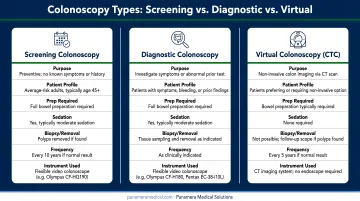
One important limitation: if a polyp or abnormality is found, a traditional colonoscopy is still required for removal or biopsy. It cannot do both in one session.
That distinction between procedure types carries financial weight, too. Insurance classification follows the same logic: screening colonoscopies generally receive full preventive coverage, while diagnostic ones may not.
Who Needs a Colonoscopy and When?
The U.S. Preventive Services Task Force recommends colorectal cancer screening for all adults aged 45–75. For average-risk individuals with no symptoms and no elevated risk factors, a colonoscopy every 10 years is the standard interval.
For adults aged 76–85, the USPSTF recommends individualized decisions based on health status and prior screening history. After age 85, the risks of sedation and procedure-related complications generally outweigh the screening benefit.
High-Risk Factors That Require Earlier or More Frequent Screening
Several conditions warrant starting earlier or returning more often:
- Family history of colorectal cancer or advanced polyps — start at age 40, or 10 years before the youngest affected relative's diagnosis (whichever comes first), per ACG guidelines
- Lynch syndrome — colonoscopy every 1–2 years, beginning between ages 20–25
- Familial adenomatous polyposis (FAP) — intensive early surveillance given the presence of 100 or more colorectal adenomas
- Inflammatory bowel disease (Crohn's or ulcerative colitis) — initial dysplasia screening 8–10 years after diagnosis, then every 1–5 years depending on risk
Beyond scheduled screening, a diagnostic colonoscopy may be ordered when symptoms suggest an underlying problem. Common indications include:
- Rectal bleeding
- Persistent abdominal pain or cramping
- Unexplained changes in bowel habits
- Significant unintentional weight loss
How Much Does a Colonoscopy Cost?
Colonoscopy pricing in the U.S. varies widely. According to CareCredit's 2025 data, the national average is $2,412, with a typical range of $1,856–$4,616. GoodRx puts the self-pay range even wider: $1,250–$4,800.
No single number reliably predicts what you'll pay — your bill depends heavily on where the procedure is performed, what happens during it, and how your insurance classifies it.
Surgery Center vs. Outpatient Hospital Costs
Where you have the procedure done is one of the largest cost variables. A 2023 Johns Hopkins analysis found:
| Setting | Standard Colonoscopy | With Biopsy | With Polyp Removal |
|---|---|---|---|
| Ambulatory Surgery Center (ASC) | $989 | $1,034 | $1,030 |
| Hospital Outpatient | $1,530 | $1,760 | $1,761 |
Hospital facility fees ran 54–61% higher than ASC fees across all procedure types. If you have a choice, confirm with the scheduling office whether your procedure will be billed as an ASC or hospital outpatient service — before you book.
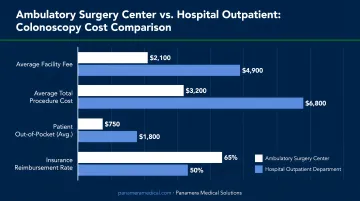
Your total bill is typically composed of separate charges:
- Facility fee (the largest component)
- Physician/gastroenterologist fee
- Anesthesiologist fee (billed separately from the facility)
- Pathology/lab fees (if tissue samples are sent for analysis)
- Bowel prep kit costs (usually $30–$100, sometimes covered by insurance)
Expect separate invoices from multiple providers, not one consolidated bill.
What Drives the Cost Higher
Three factors consistently push the final number up:
Polyp removal or biopsy — Additional pathology fees apply when tissue is removed or sampled. The Johns Hopkins data shows facility fees increase immediately when a biopsy is taken.
Geographic location — CareCredit reports significant regional variation: Hawaii averages $3,745, California $3,018, while Alabama, Arkansas, and Mississippi average closer to $2,000–$2,100.
Type of sedation — Propofol, administered by an anesthesiologist, adds a separate anesthesia charge on top of facility fees. A 2024 study found propofol used in about 35% of colonoscopies; conscious sedation covered the remaining 65%. Whether an anesthesiologist is involved often isn't disclosed until billing.
Does Insurance Cover a Colonoscopy?
Under the Affordable Care Act, most private insurers are required to cover screening colonoscopies at 100% for eligible adults — meaning no out-of-pocket costs when the procedure is classified as preventive. Medicare covers screening colonoscopies on the same basis.
Classification matters, though. If a polyp or tissue is removed during what started as a screening exam, Medicare currently requires patients to pay 15% of the Medicare-approved amount. That percentage is scheduled to drop to 10% in 2027–2029 and reach 0% in 2030.
Private insurers handle this "incidental polyp" situation differently: some cover the full procedure, while others reclassify it as diagnostic and apply cost-sharing. Verify your coverage category with your insurer before the procedure. Ask specifically: "If a polyp is removed, how will this be billed?"
Options for Patients Without Insurance
Several programs exist for uninsured or underinsured patients:
- ColonoscopyAssist: All-inclusive self-pay colonoscopies starting at $1,275 at participating gastroenterology practices
- Colorectal Cancer Alliance: Financial resource assistance and Blue Hope Prevention Awards for at-risk individuals
- CDC Colorectal Cancer Control Program: Partners with 35 award recipients to expand screening access; HRSA-funded health centers (1,400+ locations) offer income-based sliding scale fees
How the Colonoscopy Procedure Works
The scope portion of a colonoscopy takes 30–60 minutes, but plan for 2–3 hours at the facility when you account for check-in, IV setup, the procedure itself, and monitored recovery.
Step-by-Step Procedure Overview
- Arrival and check-in — paperwork, vital signs, IV line placement
- Sedation — either propofol (administered by an anesthesiologist) or conscious sedation via midazolam/fentanyl; your gastroenterologist will discuss options in advance
- Positioning — patient lies on their side on the procedure table
- Scope insertion — the colonoscope is inserted through the rectum and guided through the entire colon; the physician reviews real-time imaging throughout
- Abnormality management — if polyps are found, they can be removed immediately using instruments passed through the scope channel; tissue biopsies can be collected in the same session
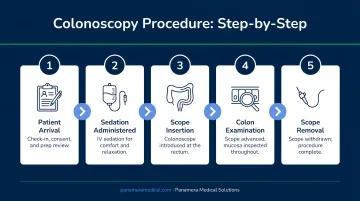
Visual findings are reviewed with you right after the procedure. Lab results from any biopsy samples typically take a few days.
Recovery at the Facility
After the procedure, you'll be monitored in a recovery area for 30–60 minutes while sedation wears off. Common side effects include mild bloating or gas cramps from air introduced during the exam — both resolve quickly. You cannot drive yourself home after sedation. Arrange transportation in advance.
How to Prepare for a Colonoscopy
Colonoscopy Prep: Diet and Bowel Preparation
The prep is the part most patients find difficult. A clean colon is essential for accurate results — if the prep is incomplete, the exam may need to be repeated.
The typical protocol:
- 2–3 days before: low-fiber or low-residue diet (no nuts, seeds, raw vegetables, whole grains)
- Day before: clear liquids only — water, clear broth, plain gelatin, apple juice, black coffee or tea; avoid red or purple liquids
- Evening before (and sometimes morning of): prescribed bowel prep laxative, often in split doses
Discuss all medications with your doctor before the procedure. Blood thinners, diabetes medications, and iron supplements typically require dosing adjustments or temporary pauses.
Aftercare and Recovery at Home
Most patients resume normal activities the following day. For the remainder of the day after the procedure, plan on taking it easy:
- Rest at home; the sedation lingers for several hours
- Reintroduce food gradually — start with light, easy-to-digest meals
- Stay hydrated; the prep process is dehydrating
- Mild bloating and cramping are expected and normal
Seek immediate medical attention if you experience severe abdominal pain, fever, rectal bleeding that doesn't resolve, dizziness, or significant weakness. Complications are uncommon, but acting quickly matters if they occur.
Frequently Asked Questions
Will insurance cover endoscopy and colonoscopy?
Most screening colonoscopies are fully covered under the ACA for eligible adults aged 45–75 — no out-of-pocket cost. However, if polyps are removed or the procedure is reclassified as diagnostic, cost-sharing may apply. Confirm your procedure's classification with your insurer before the appointment.
Do you sleep all day after a colonoscopy?
No. Most patients feel groggy for a few hours as sedation wears off, but the majority are back to normal by the following day. Sleeping all day isn't typical — though you should rest and avoid driving for the remainder of the procedure day.
Why don't they do colonoscopies after 70?
They do. The USPSTF recommends routine screening up to age 75, with individualized decisions for ages 76–85. After 85, the risks of sedation and potential complications generally outweigh the benefit of screening for most patients.
How often do people with Crohn's get colonoscopies?
Patients with Crohn's or other colonic IBD typically need more frequent surveillance — the AGA recommends an initial dysplasia screening 8–10 years after diagnosis, with follow-up every 1–5 years based on disease activity, duration, and extent of colon involvement.
What is the difference between a screening and a diagnostic colonoscopy?
A screening colonoscopy is a routine preventive exam for patients without symptoms; a diagnostic colonoscopy is ordered due to specific symptoms or risk factors. The distinction matters for insurance — screening procedures receive full preventive coverage, while diagnostic ones typically don't.
How long does a colonoscopy take from start to finish?
The scope procedure itself takes 30–60 minutes. When you include check-in, sedation setup, the procedure, and recovery monitoring, plan for approximately 2–3 hours at the facility before you're discharged.