Many facilities focus on the purchase price and miss the bigger cost picture. Reprocessing infrastructure, maintenance contracts, per-procedure accessories, and replacement cycles can collectively exceed the initial acquisition cost over a scope's lifecycle. According to a 2023 systematic review in Gastrointestinal Endoscopy, total reusable ERCP cost per procedure ranges from $849 at high-volume centers to nearly $1,908 at low-volume centers — a gap driven almost entirely by how costs amortize across procedure volume.
This guide breaks down ERCP scope pricing tiers, the factors that drive cost variation, and how to budget smartly across the full equipment lifecycle.
Key Takeaways
- New reusable ERCP duodenoscopes are priced at $35,000–$40,000; refurbished units trade in the $7,000–$22,000 range depending on model and condition
- Single-use scopes cost roughly $3,000 per unit — cost-effective for low-volume or infection-sensitive settings, expensive at scale
- Per-cycle reprocessing costs range from $80 (single HLD) to $296 (EtO sterilization) — the chosen model alone drives that difference
- Total cost of ownership over a scope's lifecycle often runs 2–3× the purchase price once reprocessing, repairs, and downtime are factored in
- Trade-in and buy-back programs can significantly reduce net acquisition cost when upgrading equipment
How Much Does an ERCP Scope Cost?
No published list price exists for ERCP duodenoscopes — OEM contracts are negotiated through GPOs or direct hospital procurement, and pricing varies by manufacturer, model generation, and purchasing volume. That said, the market breaks down into three distinct cost tiers worth understanding before any procurement decision.
New ERCP Scope (Premium/High-End)
Peer-reviewed total cost of ownership analyses have used $35,000 to $40,000 as acquisition cost inputs for new reusable duodenoscopes. These figures reflect current-generation instruments from manufacturers like Olympus, Fujifilm, and Pentax/Hoya, and typically include:
- Latest optical technology and elevator design
- OEM warranty coverage
- Compatibility with manufacturer's reprocessing guidance and disposable-component systems
This tier makes financial sense for high-volume tertiary care centers and academic medical centers that perform enough ERCPs annually to amortize the cost across hundreds of procedures.
Refurbished/Pre-Owned ERCP Scope
Publicly listed refurbished duodenoscopes show a meaningful price spread depending on model and condition:
- Olympus TJF-Q190V: $13,989–$22,170 (marketplace listings)
- Fujifilm ED-580XT: ~$19,000 average
- Pentax ED34-i10T2: from ~$6,950
These figures come from reseller marketplace data and should be treated as directional benchmarks rather than contract prices. Actual acquisition cost depends on scope condition, included accessories, and negotiated terms. Reputable suppliers like Panamera Medical Solutions, which sources and trades certified pre-owned duodenoscopes across North America, Europe, and South America, can provide current pricing based on available inventory and facility requirements.
Refurbished scopes suit mid-volume facilities or those upgrading without full capital expenditure. A certified refurbished unit should include inspection of the elevator mechanism, optics, and insertion tube, along with a limited warranty.
Single-Use ERCP Scope
Fully disposable duodenoscopes — the Ambu aScope Duodeno 2 and Boston Scientific EXALT Model D are the primary options — are modeled at approximately $3,000 per unit in cost-effectiveness analyses, with Olympus's own cost model citing $2,899 per single-use procedure versus $601 for reusable ERCP.
Single-use eliminates reprocessing cost entirely — but that savings compounds into a liability at scale. For facilities performing 200+ ERCPs per year, cumulative single-use spend can dwarf the amortized cost of a reusable system. For low-volume settings, infection-sensitive environments, or situations where reprocessing infrastructure doesn't exist, single-use often makes more practical sense.
Key Factors That Affect ERCP Scope Cost
ERCP scope pricing is shaped by technical specifications, regulatory pressures, facility-level requirements, and how costs accumulate over time.
Scope Type and Reprocessing Model
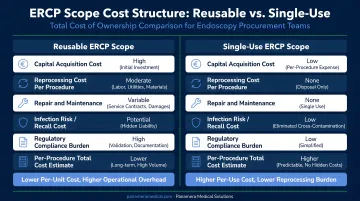
The reusable vs. single-use decision creates two fundamentally different cost structures:
- Reusable scopes: High upfront cost, amortized over hundreds of procedures, but require ongoing reprocessing infrastructure and carry infection-control complexity
- Single-use scopes: Lower per-unit cost, zero reprocessing overhead, but cumulative spend grows linearly with procedure volume
The FDA has encouraged transition away from fixed-endcap duodenoscopes toward disposable-component or fully single-use designs since its 2019 safety communication, with a 2022 update reinforcing that direction. Duodenoscopes are used in more than 500,000 ERCP procedures annually in the US, and their complex elevator mechanism has been linked to CRE transmission when reprocessing is incomplete.
That infection-control risk has pushed all major manufacturers to invest in disposable-elevator and fully single-use designs — reshaping the cost calculus for facilities evaluating their next scope purchase.
Manufacturer, Generation, and Optical Technology
Those design changes show up clearly in the current product lineup. The three major manufacturers have each taken a distinct approach to reducing reprocessing risk:
| Manufacturer | Model | Key Design Feature |
|---|---|---|
| Olympus | TJF-Q190V | Disposable distal cover; distal-end flushing adapter |
| Fujifilm | ED-580XT | Removable single-use distal end cap; sealed elevator mechanism |
| Pentax/Hoya | ED34-i10T2 | Sterile disposable elevator cap; reported 35% reduction in distal-end reprocessing surface |
Newer-generation scopes with enhanced elevator mechanisms or improved optics command a premium. Older-generation refurbished scopes offer significant savings — the trade-off is that they may carry legacy reprocessing requirements and lack current design features.
Accessories and Consumables
The scope itself is only part of the per-procedure cost. Each ERCP consumes multiple disposables:
- Sphincterotomes and guidewires
- Extraction balloons and stone retrieval baskets
- Stents (biliary or pancreatic)
- Contrast injection catheters
Historical peer-reviewed data shows a sharp cost gap between procedure types: $149 (diagnostic ERCP) vs. $532 (therapeutic ERCP) in disposable equipment costs alone. Current prices will be higher, but the ratio holds — therapeutic procedures consume 3–4x the materials of diagnostic ones.
That multiplier matters for budget modeling. Facilities with a high share of therapeutic ERCPs will see accessory spend dominate their per-procedure cost, often outpacing the amortized scope cost itself.
Reprocessing Infrastructure and Labor
A 2021 economic study quantified how dramatically reprocessing model choice affects per-cycle cost:
| Reprocessing Method | Per-Cycle Cost |
|---|---|
| Single high-level disinfection (HLD) | $80 |
| Double HLD | $118 |
| Culture and quarantine | $208 |
| Ethylene oxide sterilization | $296 |
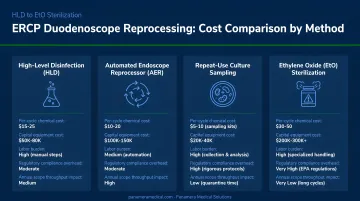
Chemistry costs are only the starting point. AER equipment, dedicated reprocessing staff, microbiological surveillance programs, and drying cabinets compound the total infrastructure burden considerably. Facilities upgrading to newer-generation scopes with disposable components should confirm whether existing reprocessing workflows remain compatible before committing to a purchase.
Full Cost Breakdown: Beyond the Purchase Price
Purchase price is only the beginning. Over a scope's lifecycle, recurring costs consistently outweigh the initial outlay.
Annual Maintenance and Repair
A peer-reviewed Gut analysis modeled reusable duodenoscopes at $1,451 in annual maintenance and repair costs per scope. ERCP scopes are mechanically demanding — three components sustain the most wear:
- Elevator mechanism: Heavily stressed during therapeutic procedures
- Working channel: Narrows with repeated reprocessing and accessory passage
- Insertion tube: Fatigues over time from angulation and handling
Without a service contract, a single repair episode can easily exceed that annual average. Facilities should budget for either an OEM or qualified third-party service agreement from day one.
Replacement Cycle Planning
The same Gut study modeled a 3-year lifetime for individual duodenoscopes under intensive use. Real-world lifespan varies with procedure volume and reprocessing frequency, but facilities should plan for periodic capital replacement rather than treating a scope purchase as indefinitely durable.
Trade-in programs, such as those offered by Panamera Medical Solutions, can offset replacement costs by applying credit from older-generation scopes toward certified refurbished or current-generation equipment.
Summarized Total Cost Components
| Cost Category | Type | Notes |
|---|---|---|
| Scope purchase | One-time | $7K–$40K+ depending on type |
| Reprocessing (per cycle) | Recurring | $80–$296 depending on method |
| Maintenance/service contract | Recurring | ~$1,451/year per scope (modeled) |
| Accessories per procedure | Recurring | ~$149 diagnostic; ~$532 therapeutic |
| Scope replacement | Periodic | Every 3–5+ years; trade-in credit available |
New, Refurbished, or Single-Use — Which Makes Financial Sense?
The right choice depends on procedure volume, infection control requirements, and long-term operational strategy.
| Factor | New Reusable | Refurbished Reusable | Single-Use |
|---|---|---|---|
| Upfront cost | $35,000–$40,000 | $7,000–$22,000 | ~$3,000/unit |
| Per-procedure amortized cost | Low at high volume | Low-moderate at mid volume | Fixed regardless of volume |
| Reprocessing burden | Full | Full | None |
| Infection control complexity | Moderate (with disposable components) | Varies by generation | Eliminated |
| Maintenance obligation | High | Moderate | None |
| Best fit | High-volume tertiary centers | Mid-volume; budget-constrained upgrades | Low-volume; infection-sensitive settings |
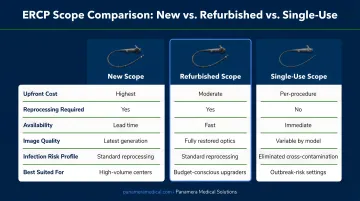
Professionally refurbished scopes from reputable suppliers can deliver comparable performance to new at a lower acquisition cost. For facilities looking to manage that cost further, trade-in and buy-back programs — like those offered by Panamera Medical Solutions — allow older-generation scopes to be exchanged toward newer refurbished units, reducing net capital outlay without sacrificing clinical capability.
How to Budget Smartly for ERCP Scopes
The right budget balances upfront capital, ongoing operational costs, and procedure volume — not just the lowest purchase price.
Before purchasing, evaluate:
- Annual ERCP procedure volume and 3–5 year growth forecast
- Existing reprocessing infrastructure and AER capacity
- Regional regulatory and infection control requirements
- Service and repair support availability for the chosen manufacturer
- Total cost of ownership over a 5–7 year lifecycle, not just acquisition cost
Once you've mapped out what you need, the next step is knowing what trips up most buyers. These mistakes consistently inflate total cost or create operational gaps after purchase.
Common budgeting mistakes to avoid:
- Focusing only on purchase price while ignoring reprocessing and service costs
- Over-specifying a premium system for a low-volume suite that can't amortize the investment
- Choosing the cheapest option without evaluating parts availability and repair frequency
- Ignoring accessory and consumable costs, which can rival equipment amortization per procedure at therapeutic volumes
- Skipping trade-in or buy-back programs, which can meaningfully reduce net acquisition cost when upgrading or liquidating older equipment
Vendors like Panamera Medical Solutions run structured buy-back and trade-in programs across North America, Europe, and South America — a practical route for facilities looking to offset upgrade costs without leaving equity on the table.
Frequently Asked Questions
How much does an ERCP procedure cost in the US?
Total procedure cost ranges from roughly $849 per ERCP at high-volume centers to nearly $1,908 at low-volume centers, based on a 2023 GIE systematic review. Patient out-of-pocket costs vary based on facility type, procedure complexity (diagnostic vs. therapeutic), and insurance coverage.
Is ERCP covered by insurance?
ERCP is generally covered by Medicare, Medicaid, and most private insurance plans when medically necessary. Patients should verify their specific coverage, deductibles, and any pre-authorization requirements directly with their insurer before scheduling.
Is ERCP considered major surgery?
ERCP is an endoscopic procedure performed through the mouth under sedation, not open surgery. It is less invasive than traditional surgical approaches but carries its own risks, including post-ERCP pancreatitis, and may involve therapeutic interventions such as sphincterotomy or stent placement.
How much does an ERCP duodenoscope cost to purchase?
New reusable duodenoscopes are modeled at $35,000–$40,000 in peer-reviewed literature. Refurbished units range from approximately $7,000 to $22,000 depending on model and condition. Single-use scopes run approximately $3,000 per unit. Actual pricing is quote-driven and varies by manufacturer, generation, and procurement channel.
What is the difference between a reusable and single-use ERCP scope in terms of cost?
Reusable scopes carry higher upfront cost but amortize to a lower per-procedure cost at high procedure volumes. Single-use scopes have no reprocessing overhead but accumulate cost linearly. At high volume, total single-use spend typically exceeds the total cost of ownership for a reusable system.
How often do ERCP scopes need to be replaced?
Replacement frequency depends on procedure volume and reprocessing cycles; peer-reviewed modeling assumes roughly 3 years under intensive use, though many facilities extend scope life with proper maintenance. Trade-in and buy-back programs can offset replacement costs by converting older equipment into credit toward newer models.