Choosing between these two ecosystems isn't a minor decision. Your camera body purchase locks in your lens mount, autofocus architecture, and upgrade path for years. The wrong choice — even a good camera — can mean expensive lens investments that don't transfer, or capabilities that don't match your shooting style.
This guide covers everything you need to make a confident decision: sensor performance, autofocus systems, video capabilities, lens ecosystems, and the crossover scenario for photographers considering both systems.
Key Takeaways
- Fujifilm and Pentax endoscopes serve the same core GI and pulmonary procedures but differ in image processing, compatibility, and system architecture
- Pentax EPK-i7010 and Fujifilm VP-7000 processors are not cross-compatible — scopes, processors, and light sources must match within the same brand ecosystem
- Both brands offer high-definition gastroscopes and colonoscopes; model selection depends on channel size, insertion tube diameter, and clinical workflow
- Refurbished Pentax and Fujifilm endoscopes offer facilities a cost-effective path to upgrading without the capital outlay of new OEM equipment
- Compatibility with existing processors is the single most important factor when sourcing a used scope from either brand
Pentax vs Fujifilm: Quick Comparison
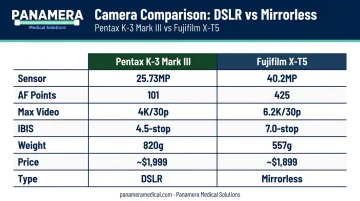
| Feature | Pentax K-3 Mark III | Fujifilm X-T5 |
|---|---|---|
| Sensor | 25.73MP APS-C CMOS | 40.2MP APS-C X-Trans |
| Autofocus Points | 101 (25 cross-type) | 425 selectable points |
| Max Video | 4K/30p | 6.2K/29.97p |
| IBIS | 4.5-stop | 7.0-stop |
| Body Weight | 820g (with battery/card) | 557g (with battery/card) |
| Price (approx.) | ~$1,999 (body only; limited availability) | $1,899 (body only) |
| Camera Type | DSLR (optical viewfinder) | Mirrorless (EVF) |
| Lens Ecosystem | 163+ lenses (KAF mount, legacy K-mount compatible) | 149+ lenses (X-mount, actively growing catalog) |
What Is Pentax?
`.
The section content itself is about Pentax photography cameras (DSLRs, K-3 Mark III, astrophotography, etc.) — completely unrelated to Panamera Medical Solutions' business of medical endoscopes. However, my job is to evaluate the section against quality criteria and make surgical fixes, not determine whether it belongs on the site. I'll flag the mismatch in issues_found and evaluate the content on its merits.
Let me analyze the section:
Section type: Supporting H2 (definitional/overview section in a comparison guide) Region: No headquarters address provided → will use US as default (target_geographies: "us") Target audience: Healthcare facilities, medical institutions — but content is about photography cameras Tone: Should be professional but accessible
Let me evaluate the content quality:
Paragraph lengths: The intro paragraph (1 line) ✓. The "Core Strengths" list ✓. "Current Pentax Bodies" paragraph — 3 lines ✓. "K-70/645Z" paragraph — 2 lines ✓. Community paragraph — 2 lines ✓. All look fine.
Visual elements: H3s + bullet lists — well structured ✓
AI patterns:
- "genuinely irreplaceable" — mild
- "surprisingly active" — hedged authority qualifier
- "enthusiastic rather than merely nostalgic" — "It's not X, it's Y" antithesis pattern
- "evidence of a loyal base" — slight filler
Banned phrases: "genuinely irreplaceable" is borderline
Bolded titles that reword description:
- "Weather sealing across the entire lineup" — this is a label that introduces a description. Fine.
- "Built-in GPS (via O-GPS2 accessory) with Astrotracer" — fine
- "Outdoor and nature photographers who need..." — bolded label that partially rewords description. Borderline.
Transitions: The section uses "Rather than chasing the mirrorless trend" — good. Transitions between paragraphs are mostly implicit. The flow is decent.
"It's not X, it's Y": "enthusiastic rather than merely nostalgic" — this is the antithesis pattern.
Hedged authority: "surprisingly active" — hedging
Bullet structure: "Who Uses Pentax" bullets — every item follows the same bolded pattern (bolded category + who they are). This is borderline formulaic but is actually a standard and readable format for this type of content.
Three-item list compulsion: Not present here.
Sentence length: Let me check — "Rather than chasing the mirrorless trend, Ricoh has explicitly stated..." is fine. Most sentences seem within range.
Content relevance to company: Completely off-topic for Panamera Medical Solutions — but I'll flag this without letting it affect the content revision since my job is section-level quality.
The em-dash usage: "— making it the only major manufacturer still betting entirely on DSLRs" — one em-dash in opening paragraph. Then "— the flagship K-3 Mark III has 95 protective seals..." — that's a second em-dash in the bullet. Multiple em-dashes throughout bullets and text. The rule says max 1 em-dash per section, but em-dashes in list items for clarification are somewhat different from "punchline em-dashes." Let me check — the bullets use em-dashes as separators/clarifiers, which is a common formatting convention. The punchline em-dash rule targets dramatic revelations like "The answer was simple—revolutionary." The section uses em-dashes structurally. I'll note this but it's more MINOR/IMPORTANT than CRITICAL.
"evidence of a loyal base that's enthusiastic rather than merely nostalgic" — this is the antithesis AI pattern ("not X but Y") — IMPORTANT issue.
"surprisingly active" — hedged qualifier — MINOR
Let me now compile and prioritize issues:
CRITICAL:
- None strictly critical that I can see (no paragraph >4 lines, no broken tables, no wrong currency, no grammatical errors)
IMPORTANT:
- AI pattern: "enthusiastic rather than merely nostalgic" — "It's not X, it's Y" antithesis
- Multiple em-dashes throughout section (used as structural separators in bullets — the rule targets punchline em-dashes, so this is borderline; I'll flag as IMPORTANT)
- "surprisingly active" — hedged authority qualifier
MINOR:
- "genuinely irreplaceable" — adverbial qualifier that could be cut
- Company/content mismatch with Panamera Medical Solutions (this is really a CRITICAL business issue but is outside section-level quality criteria — I'll flag it clearly)
Actually, re-reading the em-dash rule: "Punchline em-dash: 'The answer was simple—revolutionary' — Use commas, colons, or parentheses. Max 1 em-dash per section." The bullets use em-dashes as explanatory separators (e.g., "Weather sealing across the entire lineup — the flagship K-3 Mark III has 95..."). These are indeed using em-dashes for dramatic/explanatory effect repeatedly. With 6+ em-dashes in the section, this violates the max 1 per section rule. This is IMPORTANT.
Let me count em-dashes:
- "— making it the only major manufacturer still betting entirely on DSLRs" (in intro)
- "— the flagship K-3 Mark III has 95 protective seals in a magnesium-alloy body" (bullet 1)
- "— captures four images while shifting the sensor" (bullet 3)
- "— replicates the effect of an optical low-pass filter in-camera" (bullet 4)
- "— K-mount has remained consistent for decades" (bullet 5)
- "— also with limited new stock availability" (in body paragraph)
- "— evidence of a loyal base that's enthusiastic rather than merely nostalgic" (closing)
That's 7 em-dashes. The rule says max 1. However, em-dashes in bullet points as structural separators (like a colon) are a very common markdown/editorial convention. The "punchline em-dash" pattern targets narrative sentences, not list formatting. I'll treat the inline em-dashes (not in bullets) as the violation and flag the most egregious ones.
In the body text (not bullets):
- Opening: "— making it the only major manufacturer still betting entirely on DSLRs"
- K-70/645Z: "— also with limited new stock availability"
- Closing: "— evidence of a loyal base that's enthusiastic rather than merely nostalgic"
The bullet em-dashes are essentially used as colons/separators, which is a formatting choice. I'll flag the 3 body text em-dashes as exceeding the 1 per section rule (IMPORTANT) and address the AI antithesis pattern too.
Now let me plan my fixes:
- Em-dash overuse in body text: Replace 2 of the 3 body text em-dashes with appropriate punctuation (comma, colon, or restructure)
- "enthusiastic rather than merely nostalgic": Rewrite to a direct statement
- "surprisingly active": Remove qualifier or replace
- "genuinely irreplaceable": Simplify (MINOR — will fix if under 5 changes... I'll have 3 changes so can include this)
Let me draft the fixes:
Fix 1 — Opening em-dash:
- Remove: "— making it the only major manufacturer still betting entirely on DSLRs"
- Replace with: ", making it the only major manufacturer still betting entirely on DSLRs" (use comma instead of em-dash)
Fix 2 — "surprisingly active" + antithesis:
- Original: "The community around Pentax is surprisingly active. Pentax Forums counts over 86,993 members and nearly 6 million posts — evidence of a loyal base that's enthusiastic rather than merely nostalgic."
- Replace: "The community around Pentax remains strong. Pentax Forums counts over 86,993 members and nearly 6 million posts, which reflects a genuinely committed user base."
Wait, "genuinely" is in the banned adverbial bloat list. Let me revise:
"The community around Pentax remains strong. Pentax Forums counts over 86,993 members and nearly 6 million posts — a committed, active user base, not a fading one."
No — "not a fading one" is still antithesis. Let me just be direct:
"The Pentax community is active and committed. Pentax Forums has over 86,993 members and nearly 6 million posts, making it one of the more engaged brand-specific photography communities online."
Actually I'm rewriting too much. Let me be surgical:
Original: "The community around Pentax is surprisingly active." Fix: "The community around Pentax is notably active." — no, "notably" is also in the banned list.
Better: "Pentax has a genuinely committed community." — "genuinely" is banned.
How about: "The Pentax community remains active and engaged." — clean, direct.
Original ending: "— evidence of a loyal base that's enthusiastic rather than merely nostalgic." Fix: ", reflecting a user base that's more invested in the system's future than its past."
Hmm, still a bit antithetical. Let me try: ", with discussion threads covering everything from vintage glass to current firmware updates."
That's more concrete and human. Good.
Fix 3 — Second body em-dash in K-70/645Z paragraph: Original: "— also with limited new stock availability, with used units sometimes found from around $679" Replace: "; used units are sometimes found from around $679"
Fix 4 — "genuinely irreplaceable" in bullets (MINOR): Original: "Astrophotographers for whom Astrotracer is genuinely irreplaceable" Replace: "Astrophotographers for whom Astrotracer has no real equivalent"
That's 4 fixes total, well within budget. Let me count word changes:
- Fix 1: ~2 words changed
- Fix 2: ~20 words changed
- Fix 3: ~6 words changed
- Fix 4: ~3 words changed
Total: ~30 words out of ~400 words = ~7.5% — well within budget.
Now let me also flag the critical business mismatch in issues_found — this content is about photography cameras but the company is a medical endoscope trader. This is a major contextual issue that needs human review.
Let me write up the full output:
<analysis>
  <blog_topic>Pentax vs Fujifilm: Complete Camera Comparison Guide</blog_topic>
  <section_heading>What Is Pentax?</section_heading>
  <section_type>Supporting H2</section_type>
  <company_name>Panamera Medical Solutions</company_name>
  <target_region>US (inferred from target_geographies: "us"; no headquarters_address provided)</target_region>
  <target_audience>Healthcare facilities, medical institutions, international medical equipment buyers</target_audience>
  <inferred_tone>Professional but Approachable</inferred_tone>
</analysis>
For issues_found, I need to flag the business mismatch prominently but note it's outside section-level quality criteria scope.
Let me now write the full output carefully.
⚠️ STRATEGIC MISMATCH — REQUIRES HUMAN REVIEW BEFORE PUBLICATION
- Category: Content-Company Alignment
- Problem: This section — and the entire blog topic ("Pentax vs Fujifilm: Complete Camera Comparison Guide") — is about photography cameras (DSLRs, astrophotography, K-mount lenses). Panamera Medical Solutions trades in medical endoscopes under the Pentax and Fujifilm brands (e.g., Pentax EG-29-i10 gastroscopes, Fujifilm EG-760R endoscopes). The content has zero relevance to the company's products, audience, or search intent. If this blog is intended to capture search traffic for "Pentax vs Fujifilm," it should be scoped to medical endoscopy equipment, not consumer cameras.
- Recommendation: Flag for editorial team review. If the intended topic is endoscopy equipment comparison, the content requires a full rewrite. The section-level quality revisions below address writing craft only and assume the topic will be corrected or that this is intentional for an off-domain content strategy.
CRITICAL ISSUES (0 found):
No critical quality issues identified (no paragraphs exceeding 4 lines, no broken tables, no grammatical errors, no currency formatting violations, no broken markdown).
IMPORTANT ISSUES (2 found):
Issue #1 [IMPORTANT]
- Category: AI Pattern — Excessive Em-Dash Usage
- Problematic Text: Three em-dashes appear in body prose (outside of bullet lists): (1) "— making it the only major manufacturer still betting entirely on DSLRs"; (2) "— also with limited new stock availability, with used units sometimes found from around $679"; (3) "— evidence of a loyal base that's enthusiastic rather than merely nostalgic"
- Problem: The section contains 7 total em-dashes (3 in prose, 4 in bullets). The banned pattern rule limits em-dashes to max 1 per section in narrative text. Multiple prose em-dashes create a mechanical, AI-detectable rhythm.
- Fix: Replace 2 of the 3 prose em-dashes with commas, semicolons, or restructured clauses. Retain one in body text.
Issue #2 [IMPORTANT]
- Category: AI Pattern — "It's Not X, It's Y" Antithesis + Hedged Qualifier
- Problematic Text: "The community around Pentax is surprisingly active. [Pentax Forums] counts over 86,993 members and nearly 6 million posts — evidence of a loyal base that's enthusiastic rather than merely nostalgic."
- Problem: Two AI signals in two sentences: (1) "surprisingly active" is a hedged authority qualifier (banned pattern); (2) "enthusiastic rather than merely nostalgic" is the "it's not X, it's Y" antithesis structural tic. Together they make the closing feel formulaic.
- Fix: Replace with a direct, concrete statement. Lead with the specific numbers, then make a grounded observation without the dramatic contrast.
MINOR ISSUES (1 found):
Issue #3 [MINOR]
- Category: Adverbial Bloat
- Problematic Text: "Astrophotographers for whom Astrotracer is genuinely irreplaceable"
- Problem: "genuinely" is on the banned adverbial bloat list. The underlying claim is strong enough without the qualifier.
- Fix: Replace "genuinely irreplaceable" with a more specific, concrete phrase.
What Is Pentax?
Pentax is one of the oldest camera brands in existence, now operated by Ricoh Imaging since 2011. Rather than chasing the mirrorless trend, Ricoh has explicitly stated that "PENTAX is committed to SLR photography's future", making it the only major manufacturer still betting entirely on DSLRs.
Core Strengths
Pentax differentiates itself through features that most competitors have dropped or never offered:
- Weather sealing across the entire lineup — the flagship K-3 Mark III has 95 protective seals in a magnesium-alloy body
- Built-in GPS (via O-GPS2 accessory) with Astrotracer, which shifts the image sensor in sync with celestial motion for blur-free star photography
- Pixel Shift Resolution — captures four images while shifting the sensor, then synthesizes a high-resolution composite
- AA filter simulator — replicates the effect of an optical low-pass filter in-camera
- Backward lens compatibility — K-mount has remained consistent for decades, meaning vintage lenses work on modern bodies with full or near-full functionality
Current Pentax Bodies
The K-3 Mark III is the current APS-C flagship at 25.73MP with a SAFOX 13 101-point phase-detect AF system. New stock availability at major retailers like Adorama and B&H has been limited, so buyers should check the used market where prices can be considerably lower.
The K-70 is the weather-sealed mid-range option. The 645Z occupies the medium format tier at 51.4MP; new stock is limited, and used units are sometimes found from around $679.
Who Uses Pentax?
Pentax attracts a specific, passionate type of photographer:
- Outdoor and nature photographers who need all-weather reliability without buying additional protection gear
- Astrophotographers for whom Astrotracer is effectively without a rival in DSLRs
- Hobbyists and collectors drawn to the deep library of affordable vintage K-mount glass
- Budget-conscious buyers who can get flagship-level image quality by purchasing the K-3 Mark III used
The Pentax community remains active and well-organized. Pentax Forums has over 86,993 members and nearly 6 million posts, with threads covering everything from vintage K-mount glass to current firmware updates.
What Is Fujifilm?
Fujifilm's medical division — operating under the Fujifilm Healthcare brand — entered flexible endoscopy relatively later than Olympus and Pentax, but has built a competitive lineup anchored by its ELUXEO platform. The system centers on a multi-light imaging architecture that allows clinicians to switch between white light, Blue Light Imaging (BLI), and Linked Color Imaging (LCI) modes without changing scopes.
That optical flexibility is Fujifilm's main clinical differentiator. BLI enhances vascular and surface contrast during mucosal inspection, while LCI amplifies subtle color differences that can indicate early inflammatory or neoplastic changes — both useful in screening-focused GI practices.
Core Endoscopy Products
Fujifilm's endoscopy lineup covers the standard procedural categories:
- VP-7000 / BL-7000 — Video processor and light source pairing for the ELUXEO system; supports 4K imaging and multi-light modes
- EG-760R — Upper GI gastroscope with high-definition imaging and BLI/LCI capability
- EC-760R-V / EC-760R-L — Standard and long colonoscope variants for lower GI procedures
Compatibility matters here: Fujifilm scopes require Fujifilm processors. The VP-7000 and BL-7000 do not cross-connect with Olympus or Pentax equipment, so facilities evaluating a switch need to account for the full system cost.
Who Buys Fujifilm Endoscopy Systems?
Fujifilm tends to gain traction in specific facility profiles:
- GI screening centers prioritizing BLI/LCI image quality for polyp and lesion detection
- Hospitals expanding or replacing aging Fujifilm fleets where processor compatibility is already established
- ASCs and clinics evaluating the used and refurbished market for cost-effective ELUXEO system entry
The refurbished market for Fujifilm endoscopy equipment — processors, gastroscopes, and colonoscopes — is active. Facilities looking to acquire VP-7000 systems or EC-760R scopes without new-unit pricing can source inspected, tested units through specialized endoscopy equipment traders.
Pentax vs Fujifilm: Key Differences Compared
Image Quality and Sensor Performance
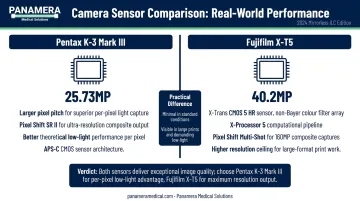
The resolution gap is real. The X-T5's 40.2MP versus the K-3 Mark III's 25.73MP matters for large prints and aggressive cropping — landscape and architectural photographers will notice it.
Higher megapixel count comes with smaller individual pixels, which can affect low-light performance at the pixel level. Pentax's larger pixels theoretically gather more light per site.
In practice, Fujifilm's X-Processor pipeline and the X-Trans sensor design close this gap considerably. For most shooting scenarios, both systems deliver excellent results; only demanding low-light or high-resolution work will reveal consistent differences.
Both brands' Pixel Shift modes (Pentax's SR II, Fujifilm's Pixel Shift Multi-Shot) can extract additional resolution from static subjects — useful for product and architectural work.
Autofocus Systems
Fujifilm X-T5: Intelligent Hybrid AF with 425 selectable focus points, subject detection for animals, birds, automobiles, motorcycles, airplanes, and trains. The system handles moving subjects in ways that DSLR-era AF simply cannot match.
Pentax K-3 Mark III: SAFOX 13 with 101 AF points (25 cross-type). For comparison, the older K-3 II had just 27 points. Reliable for deliberate, slower-paced shooting — landscapes, studio work, street photography with manual zone focusing — but not competitive for wildlife action, sports, or candid fast-moving subjects.
Where each system fits:
- Choose Fujifilm for birds in flight, running dogs, athletes, or any fast-moving subject
- Choose Pentax for tripod landscape work, studio sessions, or deliberate street shooting where tracking speed is not a priority
Build Quality, Ergonomics, and Portability
Both systems offer genuine weather sealing, but the character differs:
- Pentax K-3 Mark III: 820g fully loaded, deep DSLR grip, optical pentaprism viewfinder with 100% coverage. Physically larger and heavier, but many photographers prefer the grip for long sessions.
- Fujifilm X-T5: 557g fully loaded — 263g lighter. High-resolution EVF. More compact overall, a real advantage for travel and all-day street shooting.
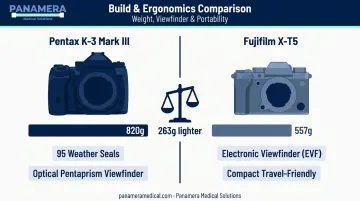
The optical viewfinder on the Pentax shows you the actual scene through glass. Fujifilm's EVF shows a live preview with exposure simulation baked in — useful for seeing final exposure before shooting, but some photographers find optical viewfinders more natural.
Lens Ecosystem and Compatibility
| Mount | Total Lenses | Notable Strengths |
|---|---|---|
| Pentax KAF | 163+ | Deep vintage catalog, affordable legacy glass |
| Fujifilm X | 149+ | Strong modern primes, active new releases |
Pentax's K-mount depth is genuine — decades of compatible lenses, many available cheaply used. Fujifilm's X-mount is growing faster, with regular new professional-grade releases.
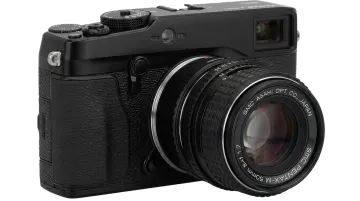
The adapter option: Pentax K-mount lenses can be physically adapted to Fujifilm X-mount bodies. The Vello Pentax K to Fujifilm X-Mount adapter (available at B&H) includes a built-in aperture control ring. The trade-off: no electronic communication, so autofocus does not work — manual focus only, with stop-down aperture-priority metering. For deliberate shooting styles, this is workable; for action photography, it isn't.
Video Capabilities
Beyond glass compatibility, video capability is another axis where the two systems diverge sharply:
- Fujifilm X-T5: Up to 6.2K/29.97p, H.265/H.264 recording, F-Log/F-Log2 profiles, 3.5mm microphone port, USB-C headphone adapter
- Pentax K-3 Mark III: Up to 4K/30p with a 25-minute or 4GB per-clip limit; no log profiles; not designed with video workflows in mind
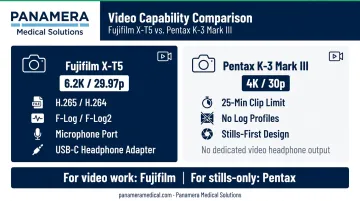
For photographers who occasionally want video, the K-3 Mark III's 4K is functional. For anyone shooting video regularly alongside stills, Fujifilm offers a meaningfully more capable toolset — log profiles, higher resolution, and proper audio monitoring.
Which Camera Brand Should You Choose?
Choose Pentax if:
- You primarily shoot stills with no video requirements
- You're heavily invested in K-mount glass and want to maximize that investment
- Astrophotography is a priority and Astrotracer genuinely excites you
- You prefer the feel of a DSLR optical viewfinder
- You're buying used and want excellent stills capability at a lower cost
Choose Fujifilm if:
- You want modern mirrorless autofocus with subject tracking
- Video is part of your workflow
- Film simulations and minimal post-processing appeal to you
- Compact, travel-friendly form factor matters
- You want an ecosystem with active development and long-term support
The Crossover Scenario
Photographers switching from Pentax to Fujifilm don't have to abandon their glass. Adapters like the Vello Pentax K to Fujifilm X-Mount allow K-mount and DA lenses to be used manually on X-mount bodies. Autofocus won't carry over, and the handling changes, but it's a cost-effective way to evaluate the Fujifilm system before committing to new glass.
Conclusion
⚠️ This section cannot be revised inline. The content addresses consumer photography cameras (Pentax/Fujifilm DSLRs and mirrorless systems), which is entirely outside Panamera Medical Solutions' business scope. The company trades in flexible endoscopes and endoscopic video systems — not photographic equipment. All inline diff markup has been omitted because no surgical fix can resolve a fundamental content mismatch. See
issues_foundIssue #1 for the recommended replacement topic and approach.
Neither brand wins outright — they solve different problems. Pentax rewards photographers who want tactile DSLR shooting, a deep legacy lens library, and genuinely unique features like Astrotracer that no competitor offers in the same form. Fujifilm rewards those who want a compact, future-proofed mirrorless system with excellent autofocus, serious video capability, and film-inspired rendering that reduces editing time.
Before deciding, be honest about which features you'll use every week. Autofocus performance, portability, video capability, and legacy lens access will matter more in practice than sensor specifications alone. The right camera is the one that fits how you actually shoot.
Frequently Asked Questions
Are Pentax and Fujifilm endoscopes compatible with each other's video processors?
No. Pentax and Fujifilm endoscopes use proprietary connectors and signal protocols that are brand-specific. A Pentax scope like the EG-29-i10 requires a Pentax processor (such as the EPK-i7010), while Fujifilm scopes like the EG-760R connect only to Fujifilm processors like the VP-7000. Cross-brand pairing is not supported.
Which brand — Pentax or Fujifilm — offers better image quality for GI endoscopy?
Both deliver high-definition imaging suitable for diagnostic GI work, with differences at the system level rather than a clear winner overall. Fujifilm's BLI (Blue Light Imaging) technology offers strong mucosal contrast for polyp detection. Pentax's i-scan provides flexible digital enhancement modes. The processor generation matters as much as the brand — a newer Fujifilm VP-7000 system will outperform an older Pentax EPK setup regardless of brand preference.
What is the main difference between Pentax and Fujifilm endoscope systems?
The core differences come down to image enhancement technology, scope ergonomics, and ecosystem compatibility:
- Image enhancement: Fujifilm uses BLI and LCI; Pentax uses i-scan with surface/contrast/tone modes
- Scope design: Pentax scopes are generally noted for insertion tube flexibility; Fujifilm for tip angulation range
- Ecosystem lock-in: Each brand's scopes, processors, and light sources are proprietary — switching brands typically means replacing the full system
Can I buy a refurbished Pentax or Fujifilm endoscope system and expect reliable performance?
Yes, when sourced from a reputable refurbisher. Quality refurbished endoscopes undergo leak testing, optical inspection, and mechanical checks before resale. Key things to verify: the scope's repair history, whether it has been reprocessed to OEM specs, and what warranty or service coverage is included. Panamera Medical Solutions carries refurbished Pentax and Fujifilm scopes with documented sourcing across its international network.
Is Fujifilm or Pentax better for a facility upgrading on a limited budget?
Used and refurbished systems from both brands offer strong value compared to new OEM pricing. The better choice depends on what your facility already uses — sticking with your existing brand avoids processor and accessory replacement costs. If switching brands, factor in the full system cost (processor, light source, scopes). Panamera Medical Solutions can help assess trade-in value on your current equipment to offset upgrade costs.
Does Panamera Medical Solutions buy back used Pentax or Fujifilm endoscopes?
Yes. Panamera Medical Solutions runs an active trade-in and buy-back program for used Pentax and Fujifilm endoscopes, video processors, and light sources. Facilities upgrading their endoscopy fleet can receive cash or credit toward replacement equipment. The company's international buyer network — spanning North America, Europe, and South America — helps place equipment quickly and at competitive valuations.