That difference matters more than it sounds. Choosing the wrong system means buying into a lens ecosystem that works against your shooting style, spending more money to compensate for a technical gap, or carrying gear that simply isn't optimized for the work you actually do.
This article covers sensor differences, stabilization, lens ecosystems, real-world use cases, and a clear situational recommendation — so you can choose with confidence rather than buyer's remorse.
Key Takeaways
- Olympus endoscopes (such as the GIF-HQ190 and CF-HQ190) are widely considered the gold standard in GI endoscopy, with the broadest installed base across US hospitals and ASCs
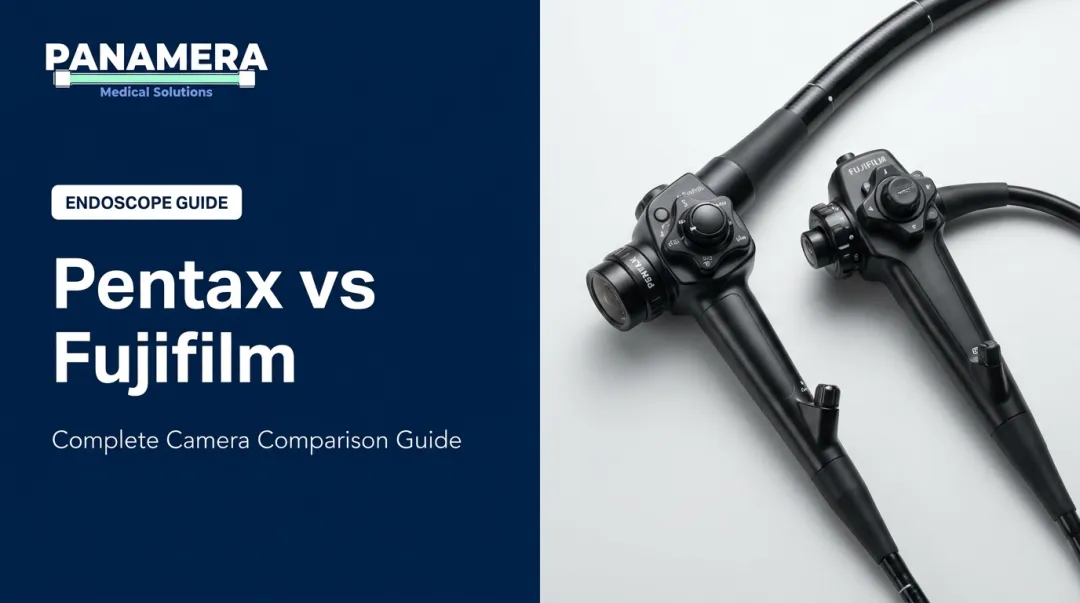
- Fujifilm's latest scopes (EG-760R, EC-760R) deliver high-definition imaging competitive with Olympus, and their VP-7000 processor integrates tightly with their scope lineup
- Processor compatibility is a critical purchasing factor: Olympus CV-190/CV-1500 systems and Fujifilm VP-7000 processors are not cross-compatible, so your existing infrastructure shapes your upgrade path
- Refurbished Olympus and Fujifilm endoscopes are widely available on the secondary market, offering healthcare facilities significant cost savings over OEM-direct pricing
- For most facilities already invested in one system, staying within the same brand ecosystem minimizes retraining costs and compatibility risk
Olympus vs Fujifilm: Quick Comparison
| Feature | Olympus Endoscopes | Fujifilm Endoscopes |
|---|---|---|
| Key Gastroscope Models | GIF-HQ190, GIF-H180 | EG-760R |
| Key Colonoscope Models | CF-HQ190, CF-H180, PCF-H190L/DL | EC-760R-V/L |
| Video Processor | CV-190 / CV-1500 | VP-7000 / BL-7000 |
| Image Technology | NBI narrow-band imaging, high-definition | BLI/LCI blue-light & linked color imaging |
| Compatibility | Olympus scopes pair exclusively with Olympus processors | Fujifilm scopes require Fujifilm VP-7000 or BL-7000 |
| Refurbished Availability | Widely available; strong used market | Growing availability; select models in stock |
| Best Suited For | GI labs with existing Olympus infrastructure | Facilities seeking BLI imaging or Fujifilm-native systems |
Both Olympus and Fujifilm endoscope lines are available as refurbished units — an effective way for hospitals, GI clinics, and ambulatory surgery centers to upgrade imaging quality without the cost of new OEM purchases.
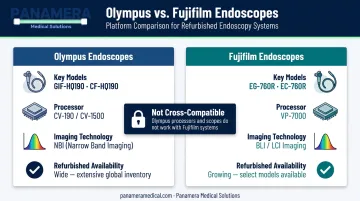
Compatibility note: Olympus scopes will not function on Fujifilm processors and vice versa. Before purchasing a refurbished scope, confirm it matches your facility's existing video processor to avoid additional upgrade costs.
What Is the Olympus Camera System?
Olympus was founded in 1919 as a precision optics manufacturer, with camera production starting in 1936. The camera division was rebranded as OM System in October 2021 after being spun off from Olympus Corporation, though legacy Olympus bodies remain widely used and fully serviced.
The MFT Sensor Advantage
The 2x crop factor is Olympus's sharpest weapon for certain types of photography. A 300mm lens becomes a 600mm equivalent, without the weight or price of a full-frame super-telephoto. For wildlife and bird photographers, that reach-to-weight ratio is genuinely difficult to match.
The tradeoffs are genuine: smaller sensors produce more noise at high ISO, and achieving shallow depth of field requires very fast prime lenses. The aperture equivalency math works against MFT in low-light scenarios.
Olympus's Core Strengths
Current OM System bodies push stabilization further than any competing system:
- OM-1 Mark II: Up to 8 EV body-only, 8.5 EV with Sync IS
- OM-5 Mark II: Up to 7.5 EV
- OM-3: 6.5 EV body-only, 7.5 EV with Sync IS
That stabilization translates directly to usable handheld exposures. DPReview's review of the Olympus OM-D E-M1 Mark III documented handheld exposures of up to four seconds on normal lenses — the kind of result that typically requires a tripod.
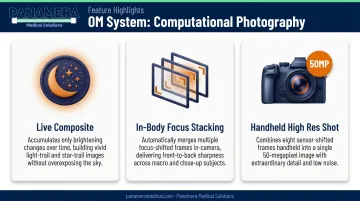
Stabilization aside, OM System also includes computational capture features most competitors haven't matched:
- Live Composite: Builds long-exposure images incrementally, adding only new light to prevent overexposure
- In-body Focus Stacking: Composites multiple frames at different focus distances for extended depth of field
- Handheld High Res Shot: Combines multiple exposures for approximately 50MP output, no tripod required
Best Use Cases for Olympus
- Wildlife and bird photography — 2x crop multiplies effective focal length; up to 120fps burst on the OM-1 Mark II enables fast subject tracking
- Macro photography — in-body focus stacking delivers results that would otherwise require dedicated rail systems
- Travel with weather sealing — weather resistance is standard on mid-range and above bodies, not a premium add-on
- Handheld low-light work with static subjects — IBIS compensates for the sensor's ISO limitations
What Is the Fujifilm Camera System?
Fujifilm launched its X-series in 2012 with the X-Pro1, building on a film photography heritage dating to 1934. The approach was deliberately analog in philosophy: physical dials for shutter speed, ISO, and aperture, rather than menu-driven controls. That tactile shooting experience remains central to Fujifilm's identity.
The APS-C Sensor Advantage
Fujifilm's X-Trans CMOS sensor uses a unique 6×6 color filter array inspired by film grain. Unlike conventional Bayer sensors, X-Trans controls moiré and false color without an optical low-pass filter. The result is strong dynamic range, clean high-ISO performance above ISO 1600, and distinctive color rendering.
The larger APS-C format (23.5 × 15.6mm versus MFT's 18 × 13.5mm) collects more total light — which means cleaner shadow detail, better recovery in post-processing, and more natural background separation.
Film Simulations: The Real Differentiator
No other camera system has a credible equivalent to Fujifilm's film simulations. Current bodies offer 19–20 modes depending on the model, including:
- Classic Chrome — muted, documentary-style rendering
- Acros — contrasty black-and-white with grain texture
- Velvia — vivid, saturated color inspired by the original slide film
- ETERNA — flat, cinematic profile suited to video
Photographer Luke Davis, featured on Fujifilm's own platform, describes images as often 95% done in-camera using baked-in simulations. For working photographers who bill by the project, that reduction in post-processing time has practical financial value.
Ergonomics and Limitations
The physical dial system creates an immersive, deliberate shooting experience. It also limits the ability to save full custom presets the way OM System bodies allow — a real trade-off for photographers who switch between very different shooting styles frequently.
IBIS availability varies across the lineup. The X-T5, X-H2, X-H2S, X-S20, and X-T50 all offer up to 7.0 stops of stabilization. The X-M5 lacks IBIS entirely. Older X-T series bodies (pre-X-T4) had no in-body stabilization at all, which historically put Fujifilm at a disadvantage for handheld video and low-light stills.
Best Use Cases for Fujifilm
- Street photography — discreet design, responsive prime lenses, fast film-style shooting
- Portrait and travel — beautiful straight-out-of-camera JPEGs reduce turnaround time
- Documentary and event work — low-light reliability and intuitive exposure controls
- Photographers who want an analog shooting feel — no digital camera replicates the Fujifilm dial experience more convincingly
Olympus vs Fujifilm: Which Is Better?
There's no universal answer. The right choice depends on four factors: shooting environment, budget for lenses, need for stabilization, and preference for in-camera color output versus post-processing flexibility.
Low Light Performance
Fujifilm holds a genuine edge here. The APS-C sensor gathers more total light than MFT at equivalent settings — the physics of sensor size favor the larger format. This advantage is most noticeable above ISO 1600 with moving subjects, where Olympus's IBIS can't help (stabilization only compensates for camera movement, not subject movement).
For static subjects in low light, the trade-off changes. Olympus's IBIS allows slower shutter speeds, making up some of the difference in sensor size. A 1/60s exposure on Fujifilm at ISO 3200 versus a 1/8s exposure on Olympus at ISO 400 can produce comparable results — but only if your subject isn't moving.
Lens Ecosystem Value
| Comparison Point | Olympus / OM System | Fujifilm |
|---|---|---|
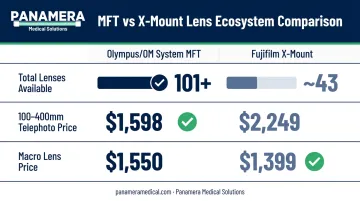
| Total lenses available | 101+ (MFT consortium) | ~43 native X-mount |
| 100–400mm telephoto | ~$1,598 (Panasonic Leica 100-400mm) | ~$2,249 (Fujifilm XF 100-400mm) |
| Macro option | ~$1,550 (OM 90mm f/3.5 Macro IS PRO) | ~$1,399 (Fujifilm XF 80mm f/2.8 Macro) |
MFT's larger ecosystem creates more price competition, particularly at the telephoto end. Fujifilm's macro glass is actually more affordable at that focal length comparison, but for long-reach wildlife lenses, MFT has a clear cost advantage.
Autofocus for Action
Current OM System bodies have largely closed the autofocus gap. The OM-1 Mark II and OM-3 both feature AI Subject Detection for birds, animals, aircraft, motorsports, trains, and humans — plus burst rates up to 120fps in RAW format on the OM-1 Mark II.
Fujifilm's interchangeable-lens bodies (X-T5, X-H2S) track action competently. The fixed-lens X100 series is a different story — PetaPixel's X100VI review notes the fixed lens motor struggles under continuous AF demands, and optical viewfinder autofocus lags noticeably behind EVF performance.
Situational Recommendation
Choose Olympus / OM System if you:
- Shoot wildlife, birds, or telephoto subjects where reach matters
- Need reliable handheld stabilization for macro or video
- Want weather sealing without paying a premium
- Want to build out a lens kit without overspending
Choose Fujifilm if you:
- Prioritize low-light performance with moving subjects
- Want minimal post-processing through film simulations
- Like shooting with physical dials for aperture, shutter speed, and ISO
- Shoot street, documentary, or portrait work
Conclusion
Both Olympus and Fujifilm produce capable endoscopic systems, but they suit different clinical environments and procurement priorities. Choosing between them comes down to your facility's procedure volume, existing infrastructure, and budget for refurbished equipment.
Here's a quick summary of where each brand tends to stand out:
- Olympus leads on global install base, broad compatible accessory availability, and widely standardized training across GI departments — making used Olympus scopes (such as the GIF-HQ190 gastroscope or CF-HQ190 colonoscope) easier to integrate into most facilities
- Fujifilm competes strongly on image quality and newer-generation features, with models like the EG-760R gastroscope and VP-7000 video processor offering solid performance at a lower refurbished price point in many markets
- Compatibility between video processors and scope generations is the most common sourcing complication — verify processor-to-scope compatibility before purchasing any refurbished system
For facilities upgrading on a budget, refurbished units from either brand can deliver strong clinical performance at a fraction of new OEM pricing. Panamera Medical Solutions carries pre-owned inventory across both Olympus and Fujifilm endoscopy lines, and offers trade-in and buy-back programs for facilities looking to offset the cost of newer equipment.
Reach out to discuss current inventory or explore trade-in options for your existing scopes.
Frequently Asked Questions
What is the difference between Olympus and Fujifilm endoscopes?
Olympus and Fujifilm endoscopes differ in image processing technology, scope design, and compatible video processor systems. Olympus uses its EVIS EXERA/LUCERA platforms, while Fujifilm operates on the ELUXEO system. Neither brand's scopes are cross-compatible — each requires its own matched video processor and light source.
Can Fujifilm endoscopes connect to an Olympus video processor?
No. Fujifilm scopes (such as the EG-760R gastroscope or EC-760R colonoscope) are only compatible with Fujifilm processors like the VP-7000. Olympus scopes require Olympus processors such as the CV-190 or CV-1500. Mixing brands requires a full system upgrade, not just a scope swap.
Is it safe to buy refurbished Olympus or Fujifilm endoscopes?
Yes, when purchased from a reputable specialist. Properly refurbished scopes are inspected, repaired to OEM specifications, and tested for leak integrity and optical performance. Panamera Medical Solutions has over 15 years of experience sourcing and refurbishing Olympus, Fujifilm, and Pentax flexible endoscopes for hospitals and clinics globally.
Which brand offers better value for used endoscopes — Olympus or Fujifilm?
Both offer strong value in the refurbished market. Olympus has broader availability due to higher global install base, which typically means more used inventory and competitive pricing. Fujifilm systems are growing in market share, and refurbished units can offer significant savings compared to new OEM pricing.
How do I know which Olympus or Fujifilm model to replace my current scope with?
Start with your existing video processor model — replacement scopes must be compatible with your current system generation. For example, Olympus CF-HQ190 colonoscopes pair with the CV-190 processor. Contact Panamera Medical Solutions with your current equipment details, and the team can identify compatible replacement or upgrade options.
Does Panamera Medical Solutions buy back Olympus and Fujifilm endoscopes?
Yes. Panamera's Trade-In and Buy-Back program accepts Olympus, Fujifilm, and Pentax flexible endoscopes and video systems. Facilities upgrading their endoscopy fleet can trade in existing equipment for credit toward newer models or receive a cash buyout for unneeded scopes.