These two brands defined the compact 35mm SLR era. Choosing between them affects more than shooting feel — it determines which lenses you can afford, how easy repairs will be, and how much you'll pay on the used market. This guide covers body specs, exposure systems, lens ecosystems, known failure points, and clear recommendations for different types of shooters.
Key Takeaways
- Olympus and Pentax both manufacture flexible endoscopes across gastroscopy, colonoscopy, and bronchoscopy categories
- Olympus dominates market share globally; Pentax offers competitive image quality at lower acquisition costs
- Processor compatibility matters: Pentax scopes require EPK-series processors; Olympus scopes pair with CV-series units
- Used and refurbished models from both brands are widely available, reducing upgrade costs significantly
- Inspect working channels, bending sections, and image quality before purchasing any pre-owned scope
Pentax vs Olympus Classic SLRs: Quick Comparison
Here's how the main rivals stack up across the dimensions that matter most to buyers evaluating used and refurbished endoscopic equipment.
Gastroscopes: Olympus GIF-HQ190 vs Pentax EG-29-i10
| Feature | Olympus GIF-HQ190 | Pentax EG-29-i10 |
|---|---|---|
| Imaging | High-definition NBI | i-scan digital contrast enhancement |
| Distal end diameter | 9.9 mm | 9.8 mm |
| Working channel | 2.8 mm | 2.8 mm |
| Processor compatibility | CV-190 / CV-1500 series | EPK-i7010 series |
| Typical refurbished price | $4,000–$6,000 | $3,500–$5,500 |
| Common service considerations | Bending section wear, angulation cables | Insertion tube integrity, light guide |
Colonoscopes: Olympus CF-HQ190 vs Pentax EC-38-i10L
| Feature | Olympus CF-HQ190 | Pentax EC-38-i10L |
|---|---|---|
| Imaging | High-definition NBI | i-scan digital contrast enhancement |
| Insertion tube length | 133 cm | 133 cm |
| Working channel | 3.2 mm | 3.8 mm |
| Processor compatibility | CV-190 / CV-1500 series | EPK-i7010 series |
| Typical refurbished price | $5,000–$8,000 | $4,500–$7,000 |
| Common service considerations | Bending rubber, insertion tube | Scope tip, angulation wire |
Video Processors: Olympus CV-190 vs Pentax EPK-i7010
| Feature | Olympus CV-190 | Pentax EPK-i7010 |
|---|---|---|
| Compatible scopes | GIF-HQ190, CF-HQ190, PCF-H190L/DL | EG-29-i10, EC-38-i10L, EB19-J10 |
| Image enhancement | NBI (Narrow Band Imaging) | i-scan (surface / contrast / tone) |
| Typical refurbished price | $12,000–$18,000 | $10,000–$15,000 |
| Key consideration | Largest installed base globally | Strong value proposition for budget-conscious facilities |
Compatibility note: Olympus and Pentax scopes are not cross-compatible with each other's processors. Before purchasing a refurbished scope, confirm it matches your existing video processor. Panamera Medical Solutions can advise on compatible pairings across its full inventory.
The Olympus OM System: Compact Revolution in Classic SLRs
The OM-1 and Its Legacy
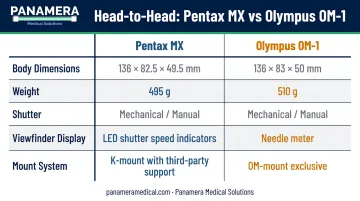
The Olympus OM-1 launched in Japan on July 20, 1972 — originally called the M-1 until Leica objected to the naming overlap. Designer Yoshihisa Maitani's goal was radical: prove an SLR could be compact without becoming cheap. He moved the shutter-speed dial to the lens mount area, shrank the mirror box, and delivered a camera that weighed 510g body-only while rivalling the build quality of cameras twice its size.
The effect on the industry was immediate. The Pentax Spotmatic it competed against was noticeably larger and heavier. Within four years, Pentax had released the M series in direct response.
The Core OM Lineup
OM-1: Fully mechanical shutter (1–1/1000 sec plus B), battery required only for the light meter. The purest manual SLR Olympus made, and the most satisfying to use. If the battery dies mid-shoot, you keep shooting.
OM-2: Introduced around 1975, adds aperture-priority auto mode with a shutter range extending to 120 seconds in auto. Same compact body as the OM-1, with identical dimensions (136 × 83 × 50 mm). The better choice for photographers who need to react quickly to changing light.
OM-10: Released 1978 as Olympus's amateur auto model. Aperture-priority only — manual control requires a separately purchased Manual Adapter, which is an awkward workaround rather than a proper implementation. Fine for casual shooting; limiting for anyone serious.
OM-20: Introduced 1983, weighs just 430 g, and has manual exposure properly built in alongside aperture-priority auto. The best value auto/manual OM body — underrated because it lacks the OM-1's visual cachet.
Advanced Second-Generation Bodies
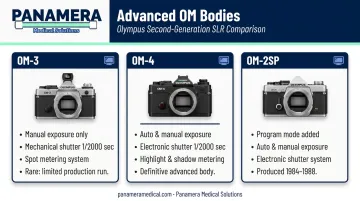
The OM-3, OM-4, and OM-2SP (released 1983–1984) replaced needle meters with LCD viewfinder displays and added spot metering:
- OM-3 — manual-only, mechanical shutter to 1/2000 sec, spot and multi-spot metering. Rare and expensive today
- OM-4 — the definitive auto/manual advanced OM body, electronic shutter to 1/2000 sec, highlight/shadow metering
- OM-2SP — adds a program mode; produced 1984–1988
One to avoid: the OM-2000 (1997) was manufactured by Cosina with an OM mount bolted on. It is not a genuine Olympus-designed body.
The OM-1/OM-2 Failure Mode: Pentaprism Foam Rot
Both the OM-1 and OM-2 use foam rubber internally to cushion the flash mechanism. Over decades, this foam degrades and releases acidic residue that etches the pentaprism silvering. The result: dark patches visible in the viewfinder that can't be cleaned away without replacing the prism itself.
Before buying any OM-1 or OM-2: Look through the viewfinder and check for dark, cloudy, or mottled patches in the corners or edges. Budget for a prism replacement if any are present.
Zuiko Lenses
The Olympus Zuiko range spans 8mm f/2.8 fisheye to 1000mm f/11, with fast primes, macro, and shift lenses throughout. Optical quality is excellent — the standard 50mm f/1.8 Zuiko is consistently praised for contrast and clarity. The limitation is mount exclusivity: Olympus OM lenses only fit OM bodies (and adapted copies), so the pool of compatible glass is smaller and more expensive than Pentax K-mount equivalents.
The Pentax Classic SLR System: From Spotmatic to the M Series
Pentax's Historical Position
Asahi Optical's Spotmatic — exhibited at Photokina in 1960 and in mass production from 1964 — defined through-the-lens metering for the industry. Pentax wasn't playing catch-up to Olympus; it had invented the modern metered SLR. When the OM-1 arrived in 1972 and proved compact could mean professional-grade, Pentax had to respond structurally.
In 1975, Pentax launched the K series (K2, KX, KM) with a new bayonet K mount, abandoning the M42 screw mount it had used for years. The K mount was more efficient to use and — critically — was adopted by third-party manufacturers, which would prove to be Pentax's most durable competitive advantage.
The K Series
- K2 — auto and manual modes, top of the 1975 lineup
- KX — manual-only, displayed shutter speed and aperture in the viewfinder
- KM — simpler match-needle metering
- K1000 — stripped-down manual-only, introduced 1976 and produced until 1997. Every exposure control is mechanical; the battery powers only the meter. Photography instructors worldwide recommended it to students for exactly this reason: it forces the shooter to understand every exposure decision directly
The K1000's teaching reputation drives its current resale values above comparable cameras. Guide values average $50–60 body-only, but the camera's reputation consistently pushes real-world prices higher.
The M Series
Released in 1976 as Pentax's compact answer to the OM-1:
- MX — fully mechanical, manual-only, LED viewfinder display. Dimensions: 136 × 82.5 × 49.5 mm, 495 g. The closest Pentax rival to the OM-1, and offers better viewfinder information through its LED shutter speed indicators
- ME — aperture-priority auto only; competed directly with the OM-10
The MX and OM-1 are the most direct rivals in this entire comparison — nearly identical dimensions, similar weight, similar build quality, different meter displays and mount systems.
The ME Super
Released in 1979, the ME Super combined aperture-priority auto with genuine manual control via push-button shutter speed selection and LED indicators in the viewfinder. It was commercially successful and remains popular — but carries a specific failure mode.
The ME Super's known fault: Degraded rubber dampers in the mirror-box mechanism cause a stuck reflex mirror and a film advance lever that winds continuously ("infinite wind"). The shutter block can also develop sticky residue from degraded rubber bumpers.
Before buying any ME Super: Confirm the shutter fires at B or 1/125 (the mechanical speeds) without a battery. If it doesn't fire or the advance won't stop, walk away or price in a repair.
SMC Pentax Lenses and K-Mount Compatibility
The K-mount ecosystem is one of Pentax's strongest practical advantages:
- SMC Pentax-M 50mm f/1.7 — the standard starting point; sharp, affordable, and easy to find
- Third-party breadth — Ricoh confirms over 380 compatible lens types, including glass from Chinon, Cosina, and other manufacturers who adopted the mount
- DSLR compatibility — modern Pentax digital bodies accept K-mount lenses, keeping vintage glass usable on current hardware — something the OM system cannot offer
Pentax vs Olympus: Which Classic SLR Should You Choose?
The right answer depends on four factors: exposure control preference, lens ecosystem priority, fault tolerance, and budget.
By Shooting Style
Choose the Olympus OM-1 if:
- You want a fully mechanical manual SLR with no electronic dependencies
- Compact body and exceptional build quality are top priorities
- You prefer a single-system approach with excellent native glass
Choose the Olympus OM-2 if:
- You want all of the above but also need aperture-priority auto for fast-changing situations
- Reportage or documentary shooting is your main use
Choose the Pentax MX if:
- Manual-only operation is non-negotiable, but you want better viewfinder metering information
- You want access to a broader used lens market at lower prices
Choose the Pentax ME Super if:
- You want both auto and manual modes with solid build quality
- Budget for lenses matters — K-mount glass is cheaper and more plentiful
Choose the Pentax K1000 if:
- You're learning exposure fundamentals and want zero automation to fall back on
- All-mechanical simplicity is more valuable than features
For Beginners
The Pentax K1000 is the clearest recommendation for anyone learning exposure fundamentals. Its all-mechanical design means every shot requires a conscious decision about aperture, shutter speed, and ISO. There's no automation to cover a mistake. The Olympus OM-10 suits beginners who want auto exposure first, with manual as an optional extra later.
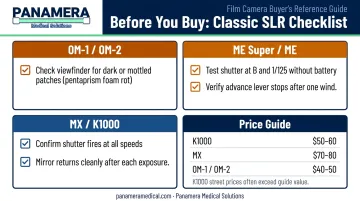
Practical Buying Checklist
Before purchasing any classic SLR from either system:
- OM-1 / OM-2: Look through the viewfinder for dark or mottled patches — that's pentaprism foam rot and means a repair is needed
- ME Super / ME: Fire the shutter at B and 1/125 without battery — both should work. Advance lever should stop after one wind
- MX / K1000: Fully mechanical means fewer electronic failure points, but confirm the shutter fires at all speeds and the mirror returns cleanly
- Price guide: K1000 averages $50–60 body-only; MX averages $70–80; OM-1 and OM-2 both average $40–50
- K1000 pricing note: Demand from film photography hobbyists regularly pushes K1000 street prices above guide value — budget accordingly
Conclusion
Neither system is objectively better — the right choice depends on your clinical priorities, budget, and the equipment already in your facility.
Olympus leads on image processor compatibility, the widest scope model range, and the broadest global service network. Pentax competes closely on optics and is often the more cost-effective option for facilities building out a secondary suite or replacing aging equipment.
When making your decision, weigh these factors:
- Compatibility: Confirm scope models are compatible with your existing video processor before purchasing
- Total cost: Refurbished units carry significantly lower acquisition costs than new OEM equipment
- Service availability: Factor in local repair support and parts availability for your region
- Resale value: Olympus and Pentax both hold strong resale value, supporting trade-in programs
A well-maintained refurbished scope from either brand can deliver years of reliable clinical performance. Panamera Medical Solutions sources, inspects, and services both Olympus and Pentax flexible endoscopes — and can help facilities evaluate which system makes sense given their current inventory and upgrade goals.
Frequently Asked Questions
Were Pentax or Olympus cameras used by professionals?
Both were widely used in the film era. The Olympus OM-1's quiet shutter and compact body made it a favourite among photojournalists — Guardian photographer Jane Bown used the same OM-1 for over 40 years. Pentax was used across press and studio work. Today, both are primarily enthusiast rather than professional tools.
Which is better for beginners: Pentax or Olympus?
The Pentax K1000 is the standard recommendation. Its all-mechanical operation forces you to learn exposure without automation. The Olympus OM-10 suits beginners who want aperture-priority auto first and manual control later, but its manual adapter is an afterthought rather than a built-in feature.
Are Olympus OM lenses compatible with Pentax bodies?
Not directly. The OM and K mounts use different bayonet systems with a flange focal distance difference of only 0.54mm, leaving almost no room for a functional adapter. Adapters exist but typically sacrifice infinity focus or require manual-only operation. The two systems are best treated as separate, incompatible platforms.
What is the most reliable classic Pentax SLR to buy?
The MX and K1000 are both fully mechanical with minimal electronic components, making them the more predictable choices. For any M-series or ME Super body, confirm the shutter fires at its mechanical speed (1/125 or B) before purchasing , as the rubber damper failure in these bodies is a known and common fault.
What are common problems with vintage Olympus OM cameras?
The OM-1 and OM-2 are most susceptible to pentaprism foam rot — degraded internal foam releases acidic residue that etches the prism silvering, showing as dark patches in the viewfinder. Inspect the viewfinder carefully before purchasing. If patches are visible, budget for a prism replacement alongside the purchase price.
Is the Pentax K mount still used today?
Yes. The K mount is one of the most enduring lens mounts in camera history, still used on current Pentax DSLRs. Vintage K-mount lenses can often be mounted on modern Pentax bodies with full or partial functionality — a long-term value advantage the Olympus OM system cannot offer.